My travels day-to-day: a diary
Throughout my travels, I kept a daily journal of my experiences—what I learned, the people I met, and the challenges I faced. Here it is.
Day 1: setting off

On the morning of 25 July 2023, I set off from Cambridge for London.
It was chaotic from the start. Electrical issues delayed the train by an hour at Stevenage, which, as usual, stressed me out. But, also as usual, I had overplanned and worried unnecessarily—I arrived at St Pancras well before check-in even opened.
Eventually, I boarded the train to Lille Flandres. The moment I arrived in Lille, I realised just how poor my French was. As I listened to the station announcements, they may as well have been in Tibetan.
I bought a coffee and waited for my next train to appear on the departures board. That was when I discovered that my bag was already broken: one of the front straps would no longer unbuckle. It had not even lasted a day. Thankfully, it was still usable.
Finally, I caught my train to Paris Nord. It was fairly crowded, mostly with people commuting home from work, although I spotted a few fellow backpackers too.
As it was already dark and my hostel was quite far from the station, I took an Uber. Unfortunately, this was also when I learned that a hostel's “self-catering kitchen” does not always mean what you expect. To my dismay, my hostel in Paris had only a fridge and two microwaves. I slowly made myself pasta in the microwave while chatting to another girl in the kitchen. It took 20 minutes and was absolutely vile.
Afterwards, I planned the following day. I decided to go on my walking tour, then use it as a way to see the sights and choose whichever attraction interested me most.
A final picture of me setting off from Cambridge station (taken by my dad)
Day 2: an unexpected night out
The Morning: My Walking Tour and What I Learned


I set off early for a walking tour that began at La Fontaine Saint-Michel.
Our guide, Harry, was from Sheffield. He told us that he had moved to Paris 10 years earlier for a girlfriend and was now on the verge of gaining French citizenship. Here is what I learned along the way.
Napoleon: Architecture as a Response to Unrest
Harry explained that the buildings surrounding the fountain were constructed after Napoleon came to power—a pattern reflected across much of Paris. There are two common explanations for this. Some believe Napoleon wanted to rebuild the city simply to make it more beautiful. However, Harry suggested there was more to it: the rebuilding was also a tool of repression.
How? Protests led by Paris's poorer residents were common at the time. By redeveloping the city, Napoleon made central housing unaffordable for many of them. As a result, poorer communities were pushed to the outskirts, where organising large-scale demonstrations became far more difficult.
Walking through the Latin Quarter The Fontaine Saint-Michel
How Did Paris Remain Intact During World War II?
We ended the tour at the Louvre, where Harry shared a hopeful story to bring the morning to a close.
He said, “You may be wondering how Paris survived World War II. The answer lies in the courage of a single general.”
By August 1944, Germany was losing ground on every front. Allied forces had broken out of Normandy and encircled much of France, forcing the Germans into a rapid retreat toward their border. Paris was left largely undefended, and Hitler knew it was only a matter of time before the city fell.
Determined that Paris should not fall into Allied hands "except as a field of ruins," Hitler ordered its appointed governor, General von Choltitz, to destroy the city’s major landmarks. At the last moment, however, von Choltitz chose not to carry out the order.
Harry concluded that it was the courage of one man—willing to defy Hitler—that made it possible for us to take this tour and enjoy the many pleasures of Paris today.

Dietrich von Choltitz
The last commander of Nazi-occupied Paris in 1944.
The Afternoon: Views from the Arc de Triomphe
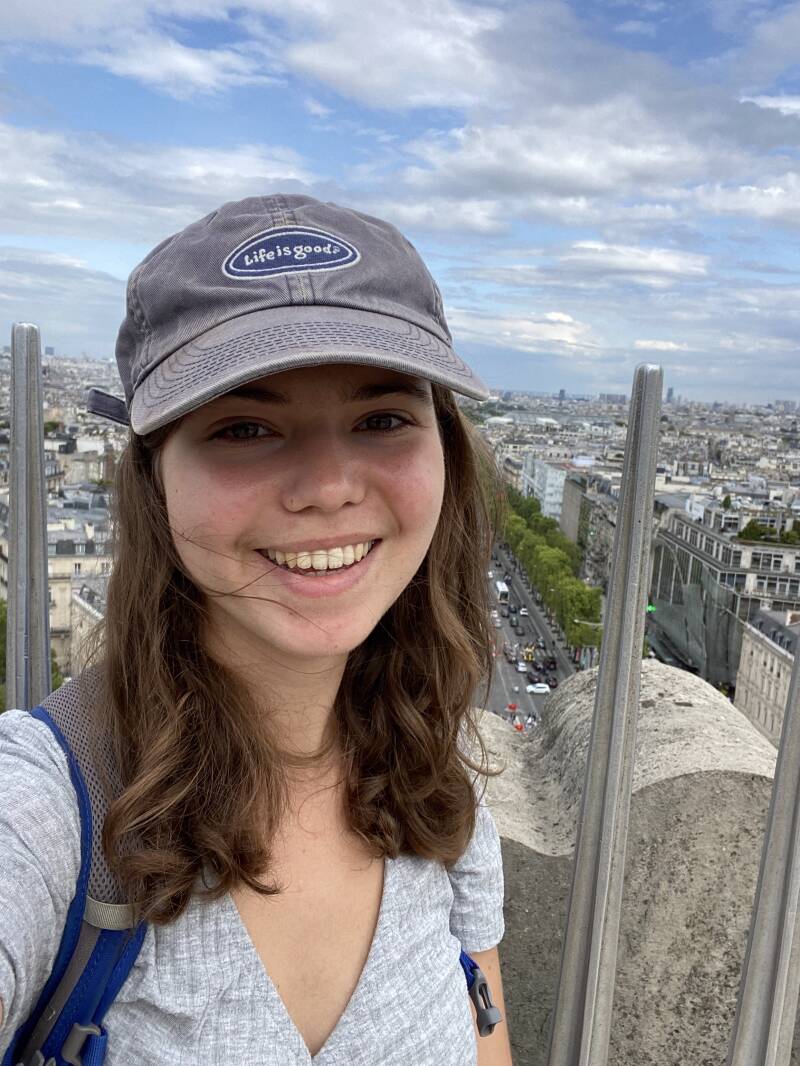

After lunch, I headed straight back out to the Arc de Triomphe. I bought a ticket to climb to the top and take in the open-air, 360-degree panoramic views. From there, I could see all 12 Parisian avenues radiating out from the monument.
I also had a front-row view of French driving. To my amazement—and slight horror—I watched cars navigate the unmarked roundabout surrounding the Arc. They seemed to drift from lane to lane without indicating, pulling out in front of one another with apparent ease. Yet, somehow, nobody crashed. I can see why we Brits are often so nervous about driving in France!
Me on my first day out
Views from the top of The Arc De Triomphe
Spectacular Views from Montparnasse
When I returned to my dorm, I met Grace and Alex, a brother and sister travelling together. They invited me to join them in Montparnasse, where they planned to visit an observation deck for a view of the illuminated Eiffel Tower.
On the walk there, Grace shared plenty of helpful travel recommendations. She introduced me to an app called Tiqets, which makes it easy to purchase tickets remotely, skip museum queues, and discover experiences offered by both companies and individuals. It proved incredibly useful at several points throughout my trip. She also told me about her passion for photography.
Once we reached the top of Montparnasse Tower, Grace took some wonderful photos of me against the spectacular Paris skyline.


One of the photographs taken by Grace (@grace.captures)
Views from Montparnasse Tower Panoramic Observation Deck
Wrapping Up at The Belushi's Bar
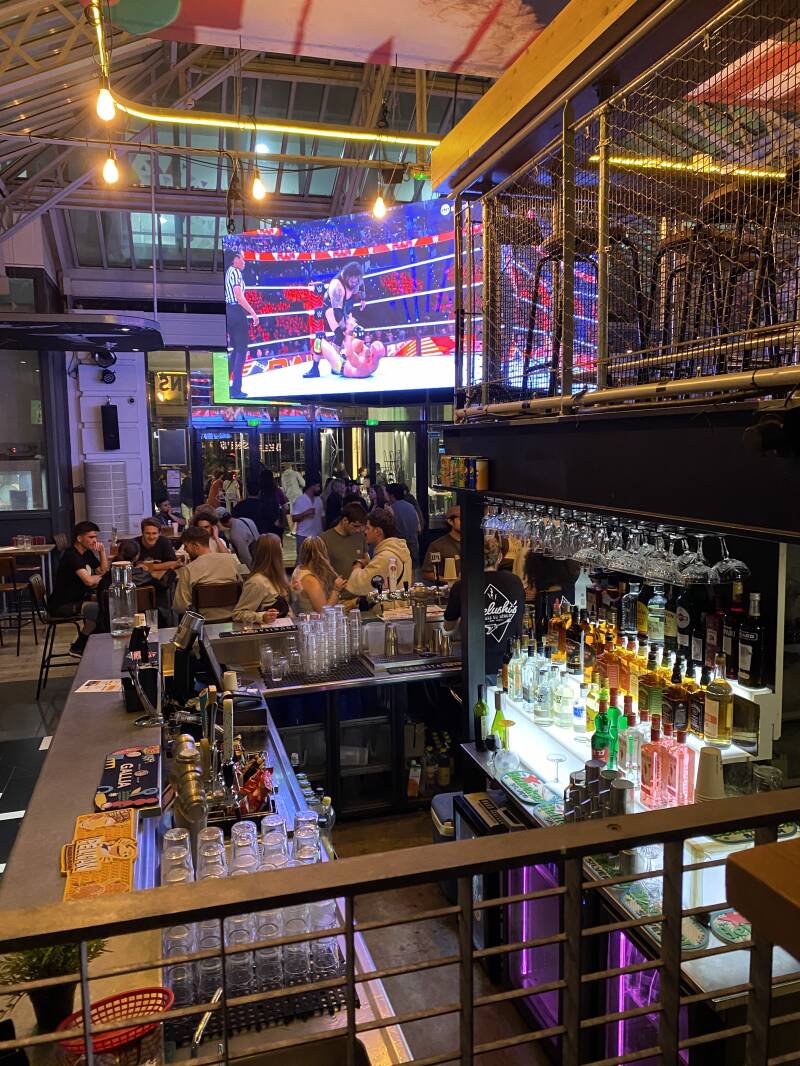
Grace, Alex, and I headed straight to The Belushi's Bar to round off the day.
The lively sports bar was packed, and we settled in with a few drinks to chat about everything we had experienced.
Overall, it was an incredible first day. I loved the walking tour and even made some new friends.
The Beluishis Bar (at Gare Du Nord)
Day 3: Matisse by Day, Sparkle by Night
My day at The Musée d'Art Moderne de Paris

After getting caught up in the excitement and spending more than £100 yesterday—oops!—I decided to make today a no-spend day. I looked up free places to visit and headed to the Musée d'Art Moderne de Paris, a major museum dedicated to 20th- and 21st-century art.
It turned out to be an incredible place to spend the day. The museum has a wonderful collection of Matisse's work, and I also discovered the remarkable artist Raoul Dufy. He created a vast mural that fills an entire room of the museum. An attendant told me it is, in fact, one of the largest paintings in the world. The mural depicts the history and evolution of electricity, from antiquity to the modern era, and features portraits of more than 100 scientists, thinkers, and inventors, including Thomas Edison and Michael Faraday.
Overall, the museum was absolutely exquisite and made me wish I had brought my art supplies. It is definitely worth a visit.
I then went and read my book at Tuileries Garden.
A section of 'The Spirit of Electricity', by Raoul Duffy
The evening: watching the lights sparkle on the Eiffel Tower
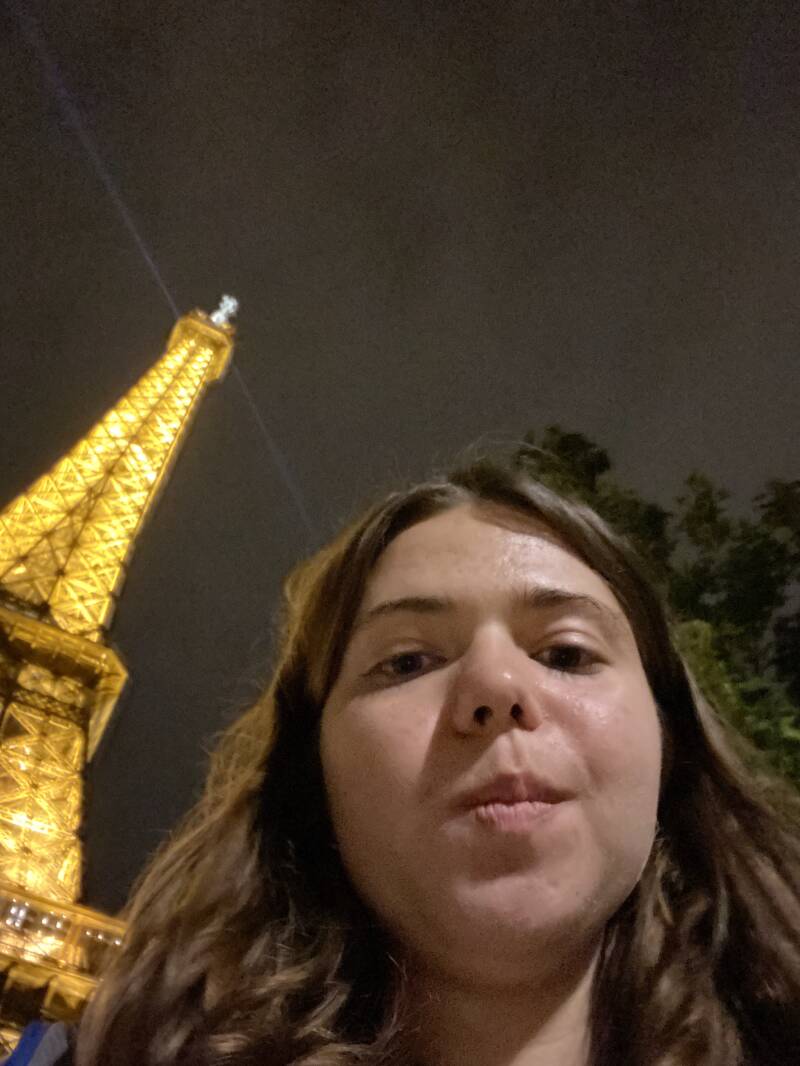
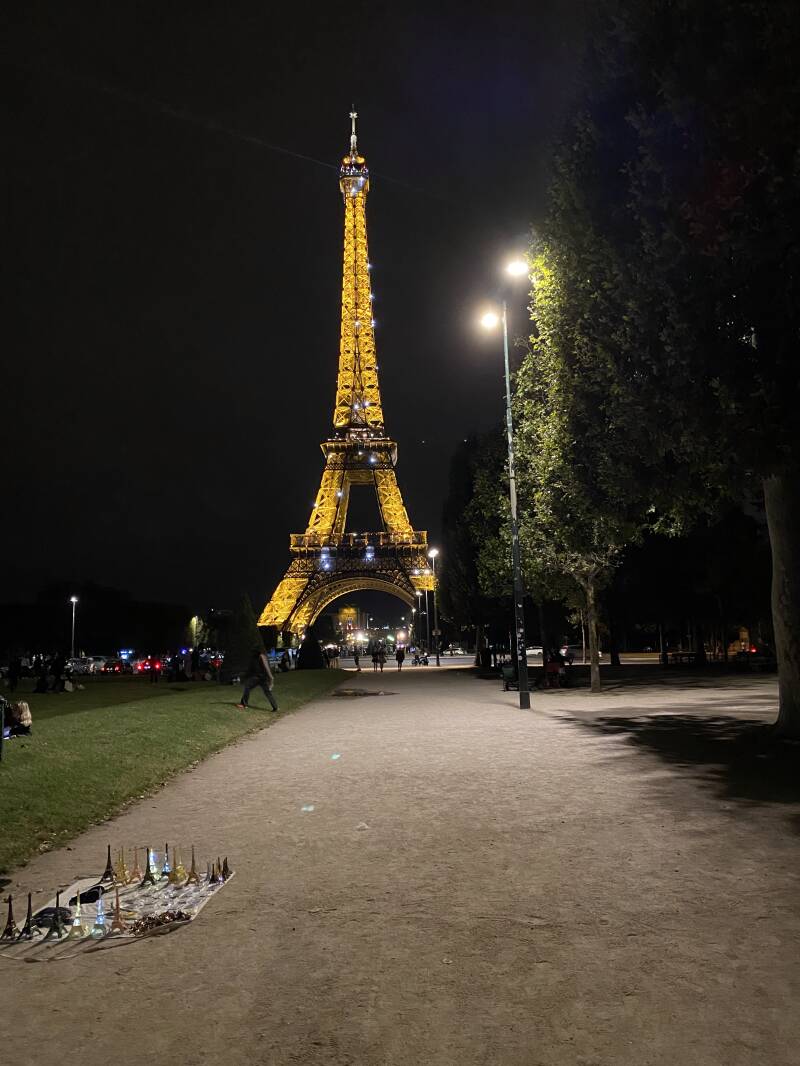
During the day, Grace texted me to invite me to once again spend the night with them. We decided to meet at the Eiffel Tower to watch the lights.
However, we ended up having trouble finding each other. I ended up walking around the tower like 3 times before we ran into each other. On a side note, to avoid situations like this yourself, I recommend the WhatThreeWords app.
We bought hotdogs at one of the many stands near the tower and then sat out on the grass watching it flash.
A great end to an amazing day. :)
Day 4: A Day Fit for a Queen
The Morning and Afternoon: Versaille
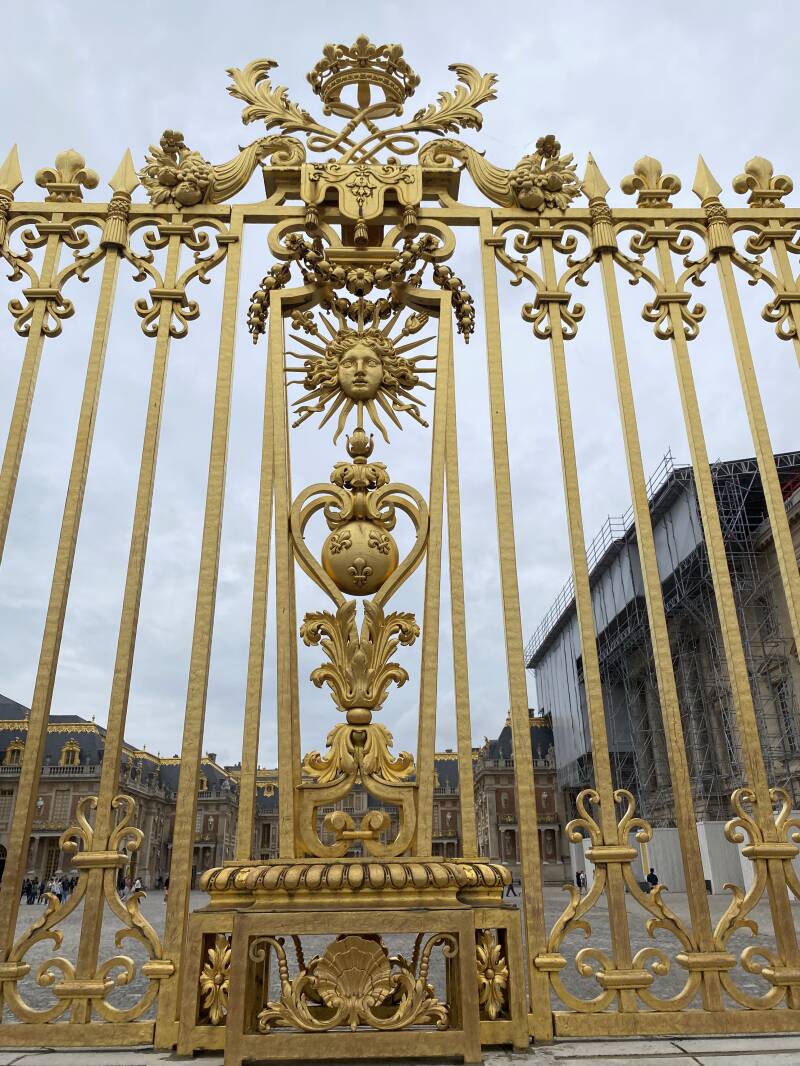
I left the hostel early in the morning to visit the Palace of Versailles, as it was quite a journey. Getting there involved taking both the metro and a bus, which took around 1 ½ hours in total.
As I was travelling on a budget, I bought a ticket that only allowed me to explore the grounds and admire the palace from the outside. Even with these limitations, it was easy to see the incredible luxury that once existed there. You can understand why there was a revolution!
For anyone planning a visit, tickets for the full experience cost 35 euros during peak season. If, like me, that is outside your budget, I personally do not think the journey is worth it just to see the grounds. Paris itself has plenty to offer—especially if you only have a few days in the city, as I did.
One of those things it offers is, believe it or not, a Starbucks. Please don’t judge me! 🥺
From Royalty to Reality: Starbucks
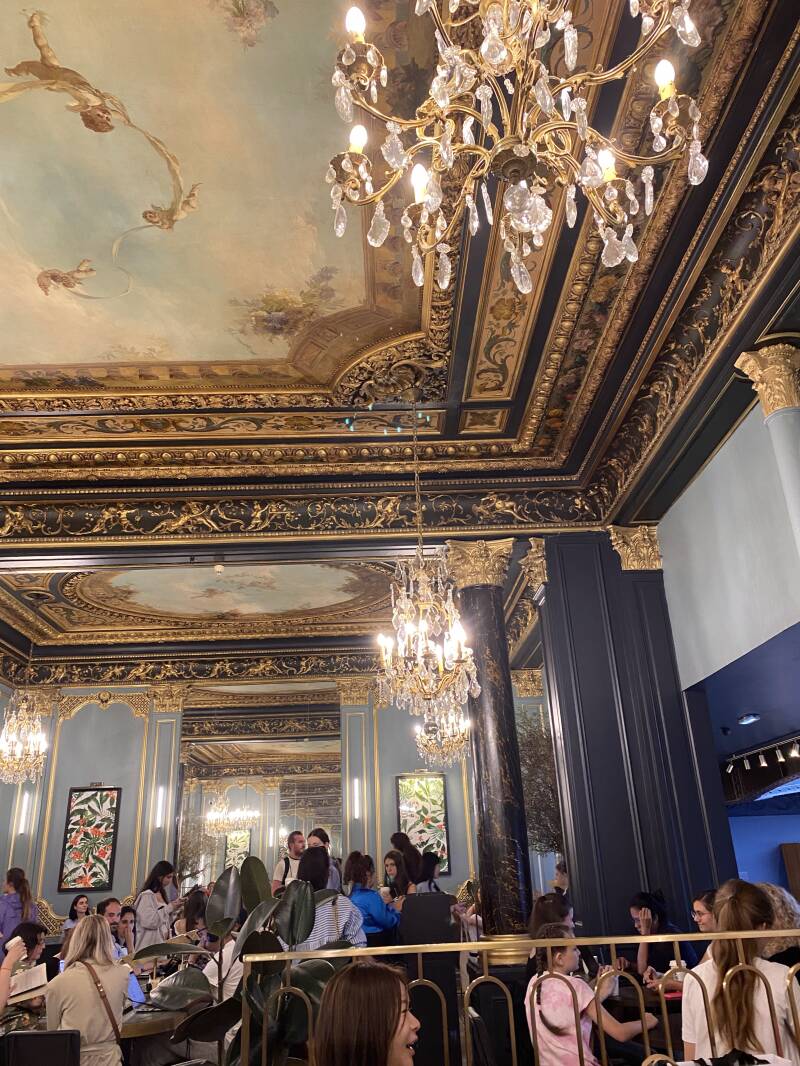
On my way back from the palace, I stopped to visit the incredibly fancy Starbucks I’d seen online—and it did not disappoint.
The walls and ceilings were covered in beautiful paintings, and even the toilets were elegant.
I know this might seem like a complete detour from the culture—and it was! Call me a typical British tourist if you like. But when you travel solo for an extended period, cramming too much culture and history into one day can become exhausting, and you may not retain much of it anyway.
It’s important to make time for the seemingly unimportant, frivolous, fun things on your list. They help keep the journey interesting!
Back to the Arc de Triomphe!
I then went back to the hostel. As soon as I got back, Grace and Alex said they were going to the Arc de Triomphe to see the Paris views and the lit up Eiffel Tower a final time. So, I booked it last minute and we went and got the metro. On a side note, the Paris metros were double decked which I thought was so odd.
Since Grace had recently had an operation on her leg, we went up in the lift this time. We took a final picture together at the top and chatted until the early hours of the morning. We then went back to the hostel to pack and prepare for the 10am check-out the next day.
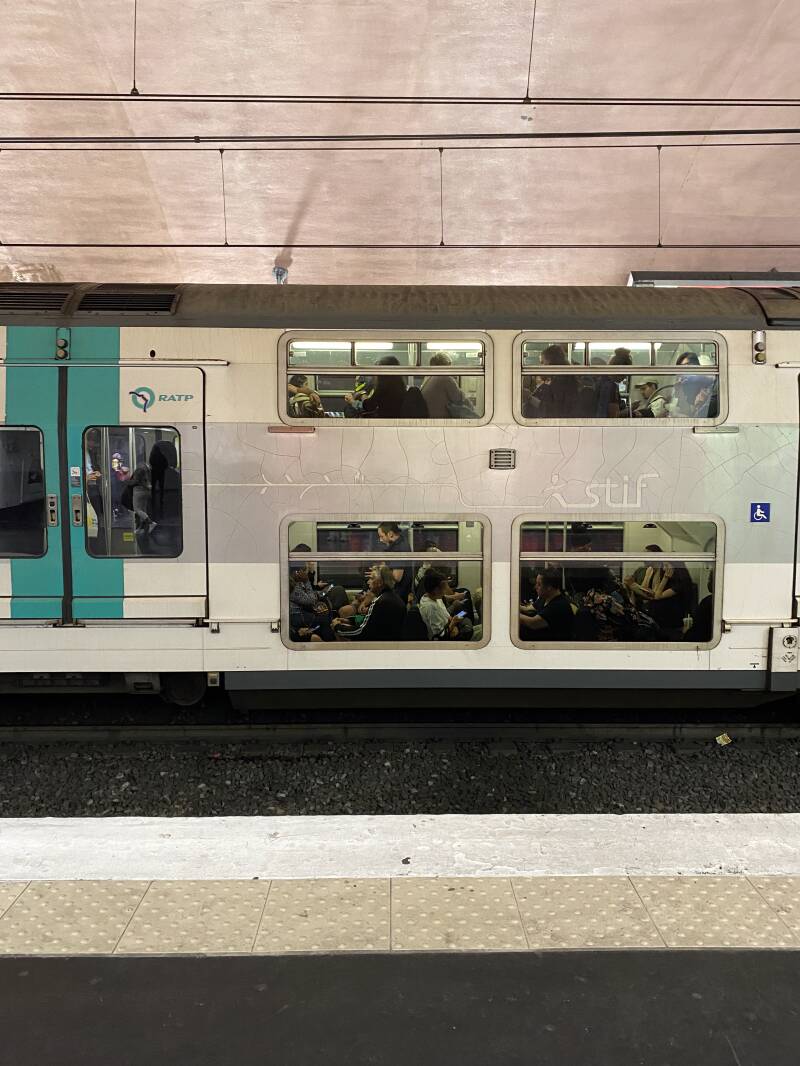

The double-decker metro
I mean what on earth! 😂
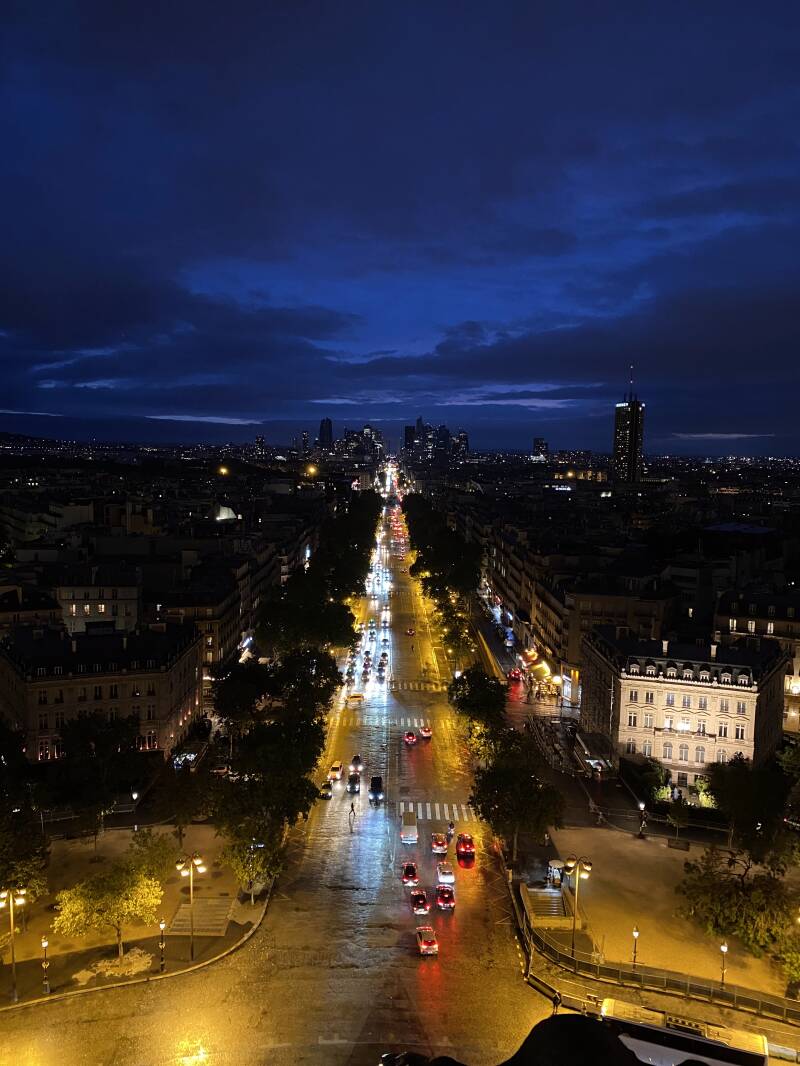
The view from the Arc de Triomphe at night
A final picture on top of the Arc de Triomphe with Grace and Alex
Day 5: from Paris to Berlin
Saying our goodbyes 😢
After checking out, Grace, Alex, and I sat in a small park in the Latin Quarter. Unfortunately, after an hour or so, it was time for me to catch my train while they headed to the airport for their flight, so we said our goodbyes.
Grace kindly said that if I’m ever in Bristol, they would be happy to show me around. I really appreciated the offer and will definitely reach out if I find myself there 😀
A Late Arrival and a Slightly Sketchy Stroll
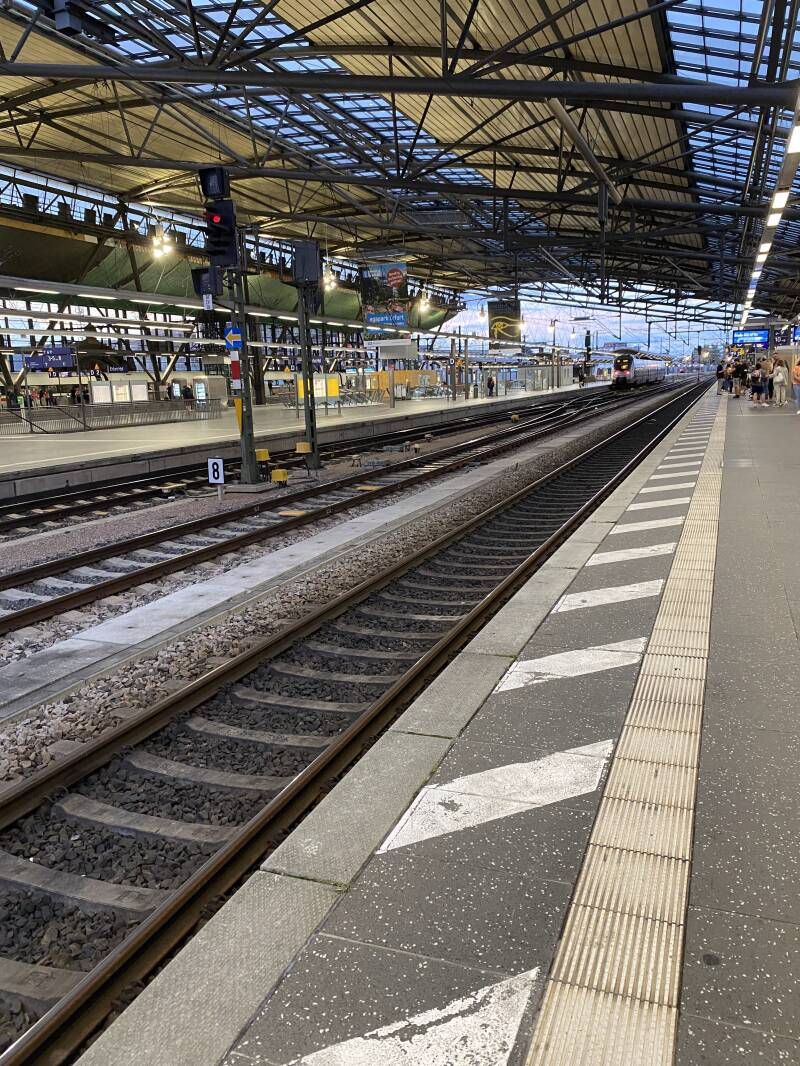
I was scheduled to arrive in Berlin at 21:53. Instead, I arrived at 1:15am.
As you can probably tell, things did not go according to plan. I made it to Frankfurt without any problems, but all the trains there were significantly delayed. It was my first introduction to German public transport—they really do arrive whenever they feel like it! 😂
At first, I was worried that I would miss check-in, but the reception team reassured me that it was open 24/7.
As it turned out, checking in late was the least of my worries. When I arrived, I realised I had a 40-minute walk to the hostel in the middle of the night—alone, with a huge backpack containing all my belongings. However, even at that time, I felt very safe in Berlin. There were always plenty of people around, mostly club-goers, and no one approached me in a way that made me feel uncomfortable. It felt very different from London and other cities I had visited, which I took as a very good sign.
I finally checked into my hostel at around 2am. Although, a group on a stag do managed to get back even later than I did!
The platform at Frankfurt
Day 6: A Day of Culture (Some of Which I Understood)
Walls that Talk
In the morning, I took a walk along the East Side Gallery. Created after the fall of the Berlin Wall in 1989, the gallery features work by 118 artists from 21 countries. Its themes reflect a period of intense political change, exploring freedom, division, and utopian aspirations. I spent a good couple of hours taking in the various pieces.
I used the East Side Gallery website as a guide, but if you prefer to listen as you explore, there are plenty of audio guides available online.
Here are a few of my favourite pieces:


Dmitri Vrubel’s 'My God, Help Me to Survive This Deadly Love'
This painting depicts the famous embrace (Bruderkuss, or fraternal kiss) between Soviet leader Leonid Brezhnev and GDR leader Erich Honecker.
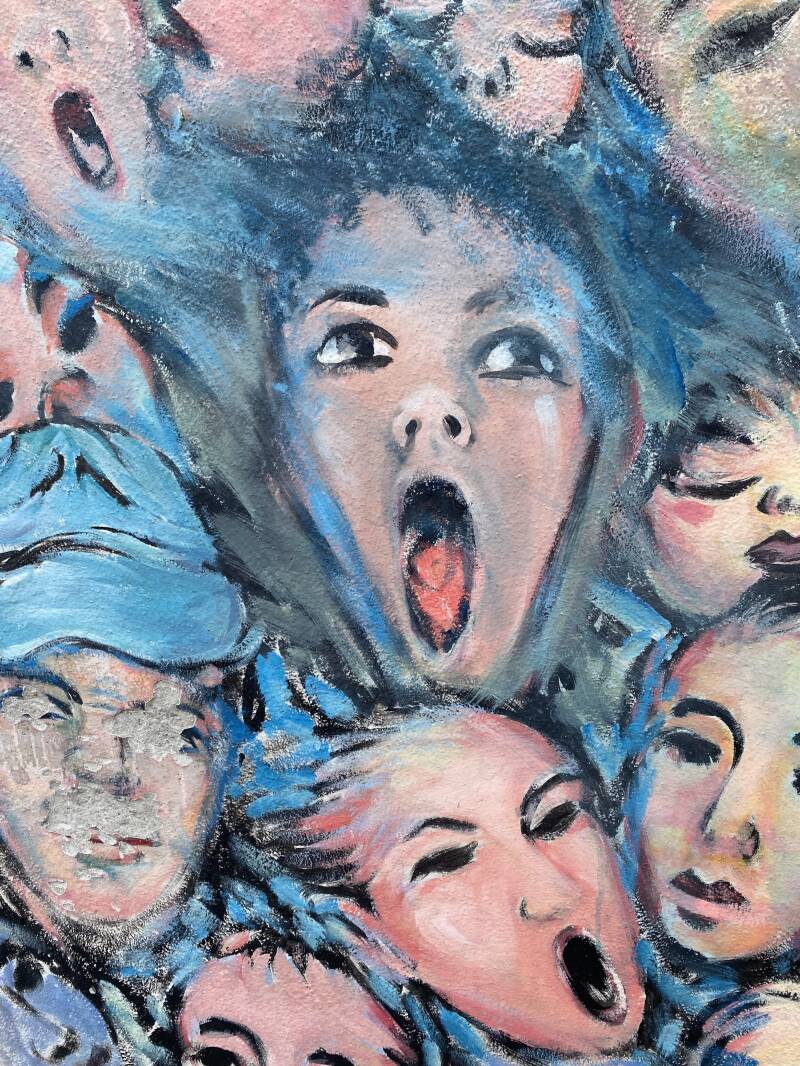
Kani Alavi’s 'The Wall Fell'
This painting depicts a crowd of faces surging forward through a gap.
Alavi, who came to Berlin in 1980, painted this from personal experience of the night of November 9 1989, when the Berlin wall finally fell.
Gabriel Heimler's 'The Wall Jumper'
The Pergamon Museum—a Museum Visit Well Above my Pay Grade!

I was lucky enough to book a ticket to the Pergamon Museum through the Tiqets app the night before my visit (I had heard tickets were extremely difficult to get during the summer).
The museum is an archaeological treasure trove, featuring full-scale architectural reconstructions of ancient structures from Greece, Rome, and several Middle Eastern countries. It also houses an extensive collection of Islamic art.
There is no doubt that the museum is incredible, and anyone with a strong knowledge of archaeology or ancient history will be completely in their element. For me personally, however, visiting without doing more research beforehand was a mistake. Much of the information went over my head, and the museum is so vast that I was not able to see everything.
Overall, I would recommend investing in an audio guide or bringing along a knowledgeable friend. Be sure to set aside a full day for your visit—the place is enormous.
That said, there was still plenty that I could understand and appreciate, which made the visit worthwhile. The Ishtar Gate of Babylon, photographed to the left, was absolutely exquisite. It is even more impressive when you consider that it was reconstructed inside the museum from thousands of excavated original fragments.
Table for One, Please!
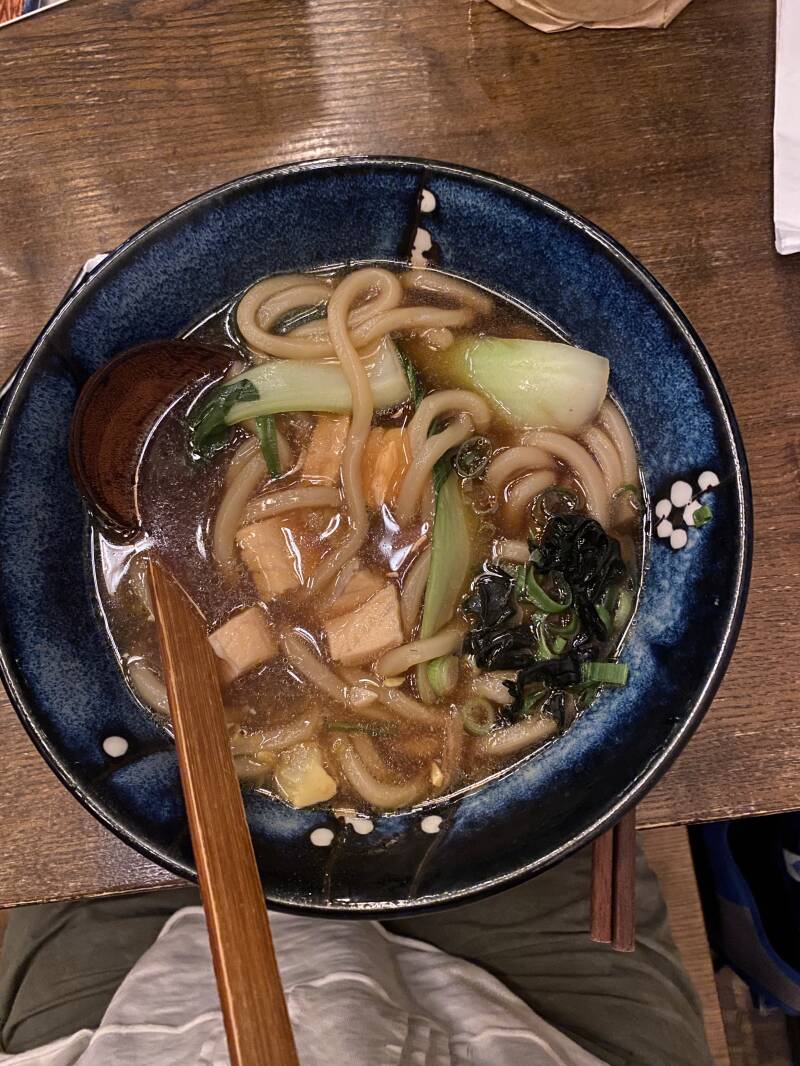
By the time I finished at the museum, it was getting late, so I quickly headed back to the hostel to make some food.
However, after taking a better look around, I realised there was no self-catering kitchen—something I hadn’t planned for. I had no choice but to go out for dinner. At that point, I had never eaten out alone before, and the prospect felt really intimidating.
Still, I pushed through and just did it. Let me tell you: everything you’re worried about is almost certainly in your head. Nobody is judging you, I promise. People are far too wrapped up in their own lives to pay you much attention. So go and get that ramen!
Day 7: A Day Behind the Iron Curtain
A Walking Tour of Communism & the Berlin Wall

First thing in the morning, I set off on a walking tour I had booked, beginning at the Brandenburg Gate. Our guide, Marcel, was incredibly knowledgeable, and I learned so much from him. Here, I’ll summarise some of the most compelling historical stories and facts I discovered along the way.
Escape attempts and victims of the Inner German border
Marcel shared many stories of people who attempted to escape East Germany. One of the most famous and successful, he explained, was Tunnel 57, named for the 57 people who escaped through it into West Berlin.
He told us that tunnels like this were dug by ordinary people who slipped out under cover of darkness and excavated them by hand.
Before taking this tour, I had never heard about these escape attempts. They seem almost miraculous to me: ordinary men and women finding a way past watchtowers, guard dogs, mines and fences, and taking such extraordinary risks in the pursuit of freedom.
This is the faces and names of those killed whilst attempting to cross the Berlin Wall

U-Bahn and S-Bahn train escapes
After walking along the Berlin Wall memorial, we then went to Bernauer Straße station.
Marcel told us that, when Germany was divided, this was a 'ghost station' for East Berlin. By this, he meant that U8 trains from West Berlin passed through it without stopping. This of course meant that the station was heavily guarded as it was a possible escape route.
However, as we've already discussed, escapes were managed. Around 150 people escaped through the U-Bahn tunnels.

Günter Schabowski speaking at the news conference

The storming of the Berlin Wall
The Blunder That Led to the Fall of the Berlin Wall
The most fascinating thing I learned was how the Berlin Wall finally fell. Surprisingly, the final catalyst was the mistake of a single man.
Ever since the Berlin Wall was erected, protests had been steadily gathering momentum. By 1989, however, they had reached a peak. The GDR therefore called an urgent meeting to discuss how to ease the growing tensions. A plan was agreed upon: people would be told they could travel between East and West Berlin, but only with a visa. Officials would then spend months deliberating over visa applications before rejecting them, in the hope that the protests would lose momentum in the meantime.
The plan might have worked if Günter Schabowski, the man responsible for announcing the proposed policy change, had attended the meeting and understood the details. But he had not. In fact, he first learned of the plan shortly before a news conference, when the meeting notes were hurriedly handed to him.
So, when he was asked the inevitable question—“What is the response to the protests?”—he had no immediate answer. He quickly scanned the notes and read aloud, somewhat perplexed, that “private travel outside the country can be applied for without pre-requisites” or “conditions.” When stunned reporters asked when the policy would take effect, Schabowski replied, equally stunned, “Immediately.”
The announcement prompted tens of thousands of people to march to the Berlin Wall, ultimately bringing about the fall of the Iron Curtain.
If you are interested, an English-translated version of the press conference can be viewed two minutes into the following YouTube video:
Life in East Germany: An Interactive Experience

Marcel recommended that we visit the DDR Museum, an interactive museum that explores what life was really like in East Germany.
After the walking tour, I headed straight there to look around—and it was incredible. The exhibition covered every aspect of life in former East Germany, including education, work, sports, and much more. Everything was presented in a fun, interactive way that made learning engaging. The museum also offered a remarkably thorough and balanced look at life in the DDR, exploring both its benefits and its drawbacks. For example, it highlighted universal social welfare alongside the realities of surveillance, travel restrictions, and frequent shortages.
I learned so much during my visit, and it is well worth seeing for anyone interested in Berlin’s history.
A typical home in East Germany
(Staged in the DDR Museum)
Day 8: From Hitler to Happy Hour (With a Side of Coughing)
Exploring Berlin's Darkest History

This was the day I began to feel really unwell, with a chesty cough and a temperature—something that would become very relevant later in my trip. For now, though, I picked up some medication from the nearest pharmacy and some jeans from primark (I hadn't brought any) and joined another walking tour, this time focused on Nazi Berlin and the Second World War. Our guide, Natalie, was exceptional—just like Marcel. Once again, let me take you through what I discovered.
The Great Gate Heist
The walking tour began at the Brandenburg Gate, where Natalie told us the story behind the statue that sits on top. It originally stood in Prussia, but when Napoleon conquered the region, he took it back to Paris with him. Years later, Germany reclaimed it. Since then, the goddess has been positioned to stare directly down at the French embassy, as if guarding against any future French invasion. Savage!
The Brandenburg Gate
A Dark Discovery at Berlin's Holocaust Memorial
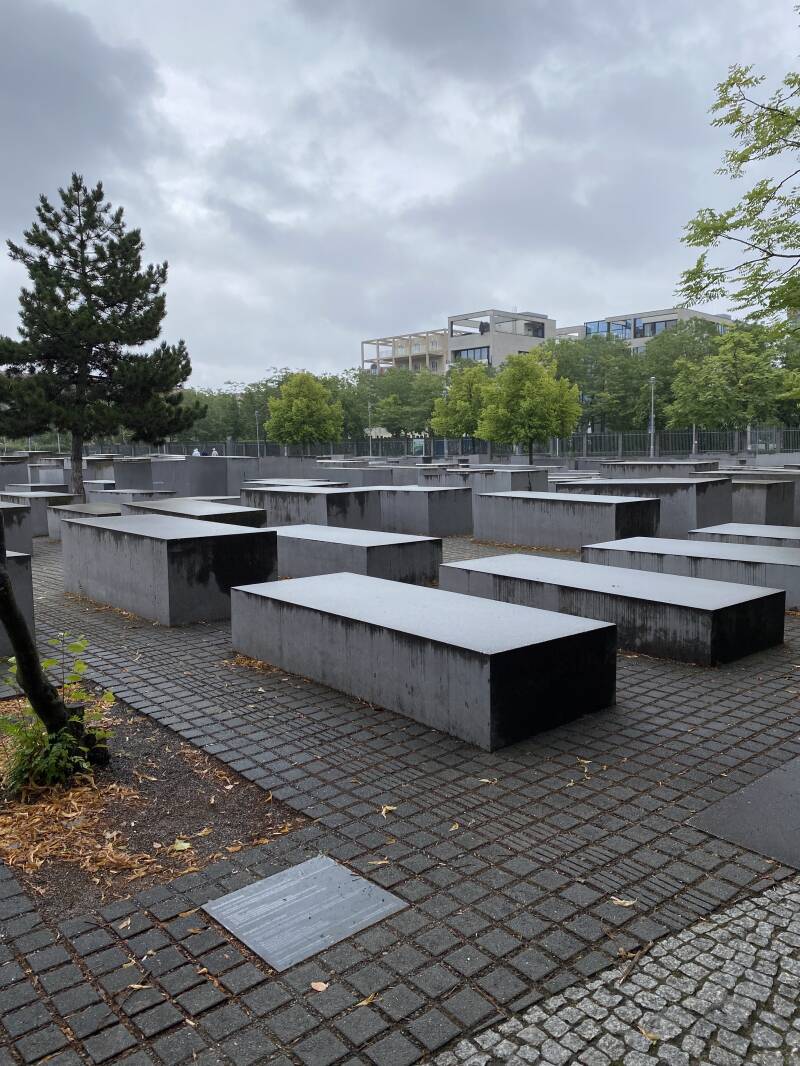
At one point during the tour, we stopped at the Memorial to the Murdered Jews of Europe. The memorial consists of concrete blocks arranged in a grid, gradually increasing in height as you move toward the centre. Natalie explained that the design was intended to evoke feelings of isolation, disorientation, and unease in those walking through it. It certainly achieved that. In the centre, the blocks rise so high that you can no longer see over them, leaving you to navigate narrow, sloping passageways by instinct. There was no denying the power of the piece.
However, its construction was not without controversy. Natalie told us that work on the memorial had to be halted partway through when it emerged that the company supplying its graffiti-resistant coating was the same company that had manufactured Zyklon B, the gas used to murder millions of Jews during the Holocaust—the very people the memorial was created to honour.
I was absolutely floored by this revelation. My first thought was, “You couldn’t make this up.” It was a stark reminder of how easily the details of past tragedies can be forgotten—and of why memorials like this one remain so important.
Memorial to the Murdered Jews of Europe
(Designed by architect Peter Eisenman)
Museum: the Futurium

After the walking tour, I felt overwhelmed by the amount of historical information I had taken in. So, I decided to follow it by visiting a light, entertaining museum. A quick Google search led me to the Futurium, which was described as an exhibition exploring humans, nature, and technology.
However, I have to admit that I did not enjoy this particular museum. In my opinion, much of the content felt like a waste of time. For a museum focused on the future, it seemed surprisingly outdated: the few concrete examples of future technology dated back to 2018. Most of the rooms were filled with abstract, playground-like installations rather than engaging exhibits. I might recommend it for children, but otherwise, I would say it is worth skipping. The robot was cute, though 😊.
The Berliner Dom


I ended the day with a visit to the Berliner Dom, Germany's largest Protestant church. For 15 euros, I climbed the stairs to the cathedral's roof and was rewarded with panoramic views across Berlin.
It’s a wonderful spot for photos and a moment of relaxation!
Scooting Into Trouble

I got back to the hostel relatively late and found that a couple of girls had just checked into my room. They invited me to join them and a guy called Charlie, who was staying in another room, on a bar crawl. I happily accepted—Berlin is famous for its nightlife, after all!
Our first stop was Birgit, a sprawling open-air beer garden. Over a few drinks, Charlie told me all about his solo trip through Asia. When I admitted that I was a little nervous about going out alone at night, despite wanting to experience the nightlife in every city, he gave me some great advice. He told me about organised pub crawls, which are available in cities all over Europe. You meet up with a group and move from bar to bar together, so you are never on your own. I made a mental note to book one in every city from then on. Thanks, Charlie!
We then decided to head to a techno nightclub called Tresor. It was a 40-minute walk away, so we opted for electric scooters—something I had always been too scared to try. By that point, though, I was very drunk, so I went for it happily 😂. They were so much fun and, by the way, quite a bit cheaper than in London!
The nightclub was incredible. We walked down a 30-metre tunnel that opened into a smoke-filled basement, where the music was amazing. That was the night I fell in love with techno and dancing to it—a passion that would later become a staple of my university experience in London.
Day 9: Clean Clothes, Poor Health
Coffee & Clean Clothes (a win-win!)
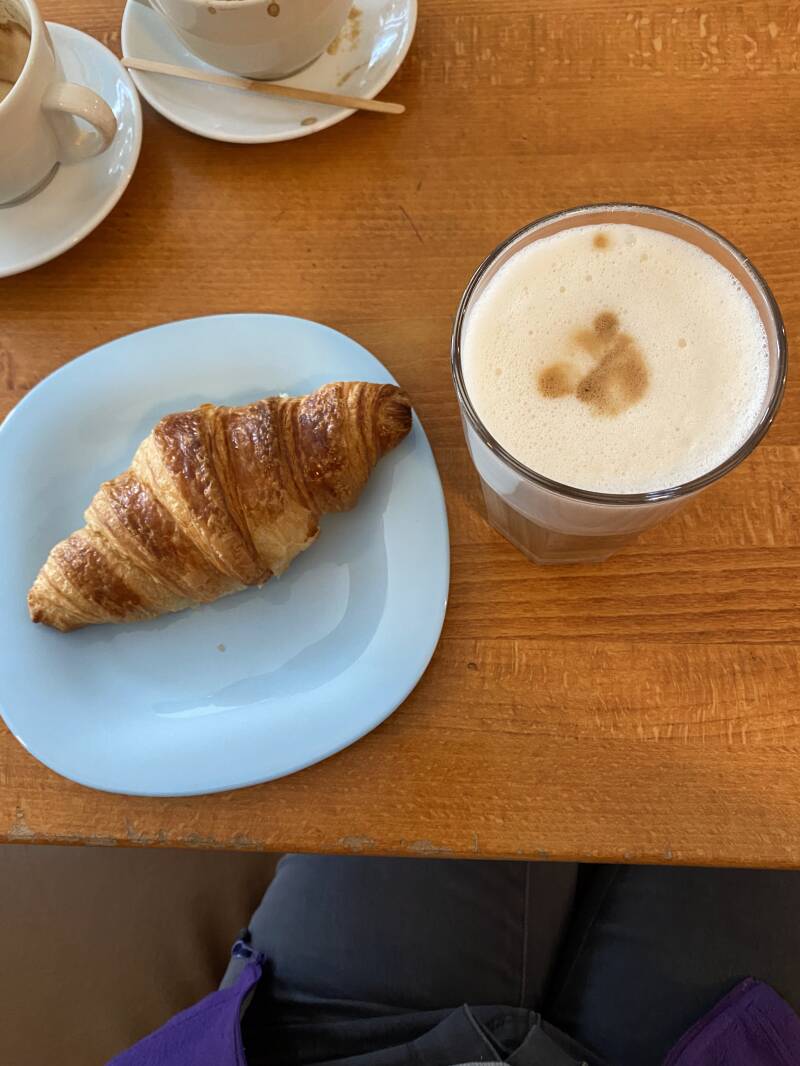

After a night out in the cold, my illness had unsurprisingly gotten worse. So, I decided to take it easy this day by dedicating the morning to doing my laundry for the first time.
Luckily there was a laundromat only 2 minutes walk from me called Waschsalon 115 GmbH. I highly recommend this laundromat for anyone visiting Berlin. You can wash and dry your clothes relatively cheap for only 7 euros. There is also a café where you can sit with a coffee and a pastry, waiting for your clothes to be done.
As you can see, I got a latte and croissant. 😊
A Visit to Berlin's Jewish Museum
After taking a hell of a lot of Sudafed and drinking far too much coffee, I felt well enough to head out for another day. I chose to visit the Jewish Museum, which explores the history of Jewish life in Germany from the Middle Ages to the present day.
A Sobering Reminder of Ongoing Antisemitism
When I arrived, I was surprised to find airport-style security at the entrance. Every visitor was required to pass through metal detectors and have their bags screened by X-ray. There was also a visible police presence around the museum. When I mentioned this to a museum attendant, she explained that it was due to persistent, systemic threats against Jewish and Israeli institutions across Europe, including the museum itself. I was shocked. Surely, in Germany of all places, antisemitism would have been eradicated? But no—it remains a disgusting feature of societies around the world, alongside every other form of racism. It was a sobering way to begin my visit.
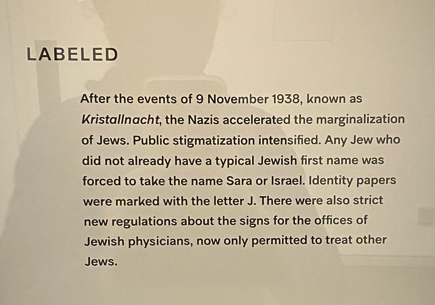
A Look at Jewish History During the Holocaust
I thought I had a fairly good understanding of how Jewish people were treated during the Second World War, based on what I had learned at school and through my own reading. This museum showed me how much I still had to learn.
I had not understood the countless smaller acts of persecution inflicted on Jewish people long before the camps. The museum presented these measures plainly and unflinchingly. Although there were many, two stood out to me in particular. One was the requirement for Jews to adopt recognisably Jewish names (see the information board to the left for more detail). Another was the restriction placed on Jewish doctors, who were permitted to treat only Jewish patients, causing severe financial hardship.

Art as a Form of Remembrance
The museum also contained many art pieces on the Holocaust of various different mediums. Two in particular stand out in my memory.
The first is a piece called Gallery of the Missing by Via Lewandowsky. It consists of 3 opaque, black trapezoidal sculptures. When you draw near to them with special headphones on, you can hear a a voice describing obliterated objects in German and English. This piece serves as a stark reminder of the large-scale destruction of Jewish cultural property during the war that can never be undone.
The second is a piece called Fallen Leaves by Menasche Kadishman (photographed to the left). This piece consists of over 10,000 heavy, round iron plates with coarsely cut-out faces. These faces each have open mouths, screaming. Visitors are invited to walk directly across these faces which creates a loud clanking sound that echoes around the room. To me, this act of treading on these thousands of faces served as a visceral reminder of how ordinary people can overlook or participate in atrocities (as happened in Germany).
Fallen Leaves, by Menashe Kadishman

Discovering the Wider Story of Jewish Culture
However, this museum was by no means solely focused on the Holocaust. Large sections were dedicated to Jewish culture, including music, religion, and everyday life.
For example, the religion section explored both daily and ceremonial traditions. It featured ritual objects such as Torah ornaments, menorahs, and kiddush cups, alongside traditional garments. It also provided valuable historical context for key life events, including birth, bar and bat mitzvahs, and marriage.
Overall, the museum was absolutely incredible. Because it was so vast, I was unable to take in everything it had to offer. I would definitely recommend setting aside an entire day to explore it properly.
When I returned to the hostel, the girls invited me to go out again. By that point, however, I could tell I was becoming quite ill and needed to rest, so I had an early night.
A scroll of the Torah, kept at the museum
Day 10: from Berlin to Prague
4 hours on the Floor
I took the 9am train without a seat reservation to save money. However, bear in mind that during the summer, this will almost certainly mean sitting on the floor. In my case, I ended up next to the toilets with a group of boys I met on the platform. It was good fun though!
Food Recommendations from a local

Eventually, after four hours, a seat became available and I found myself sitting next to a Czech woman named Anna, who was travelling home to Prague. She had studied psychology at university, so we spent ages chatting about it, as I had studied psychology at A-level. She gave me a long list of Czech foods to try and insisted that I visit the forests, which she described as incredibly beautiful.
Unfortunately, as you’ll hear, I became too ill to follow any of her recommendations. I’ve included them here, however, for anyone visiting Prague who would appreciate some local advice.
As soon as I got to my hostel, I made some food and went straight to sleep, preparing for my walking tour early the next morning. A couple of girls from my dorm (one of them was called Rachel) invited me to go out with them tomorrow night! 😊
The notes-app note I made on the train
Day 11: Strudel, Castles & Questionable Health Choices
A Slightly Underwhelming Walking Tour


I had booked the Prague Old Town and Jewish Quarter Guided Walking Tour which I was expecting to be more historical in nature. However, the man leading this tour focused mainly on myths and legends in the region. This was not something I was particularly interested in personally but if you are into that this walking tour is for you. Personally, if I was to do it again I would have booked the other tour on Prague during WW2 and the communist era.
However, there was one particular legend he told us about (alongside the historical context) which I found really interesting and which made the tour worthwhile to me. That legend was the legend of Golem.
The Golem of Prague
The Golem of Prague is a famous Jewish-Bohemian legend about a giant artificial creature sculpted from clay and brought to life through mystical Kabbalistic rituals.
Our tour guide told us that the Jewish community invented him in order to protect the Jewish Ghetto of Prague from anti-Semitic pogroms.
Cutting the tour short 🤒
Unfortunately, I had to leave the tour early (although of course I tipped) because this point I was feeling really rotten and drained. I went back to the hostel to take a nap before my night out.
The astronomical clock
Making new friends whilst watching the Petřín Lookout Tower

After we'd had dinner together, me, Rachel and a group of others went out on the town. We walked up to Prague castle to get a view of the whole city. It was absolutely spectacular.
Later, we stopped at a bar for a few drinks and sat outside, with a view of the Petřín Lookout Tower, often called the Czech version of the Eiffel Tower. Looking back, sitting out in the cold was probably a bad idea—the last thing my body needed at the time. But I was having fun, and I made friends with Rachel. She told me she was taking one final solo trip before starting a new job in software engineering.
Overall, it was a lovely night. Little did I know, it would be my last night out for quite some time.
A view of the city and the stairs up to Prague castle
Day 12: The Day My Body Finally Gave Up
Prague Castle

I set off early to visit Prague Castle, and it was truly beautiful. I ended up spending most of my time in the museum, which tells the story of the castle.
The exhibition traces the castle's many rulers, from the Bohemian kings to the Holy Roman emperors, while also exploring how the castle’s architecture evolved across these distinct historical periods. I found it completely fascinating, as before arriving in Prague, my knowledge of Czech history extended little beyond the post-war era.
My favourite artifact in the exhibition was a painting titled The Defenestration of Prague. At first glance, it depicts people being violently thrown from a window, which immediately intrigued me. When I looked into the historical context behind the scene, it turned out to be really interesting.

The Defenestration of Prague (a painting)
This painting depicts a particular historical event when angry Protestant Bohemian nobles threw two Catholic royal governors and their secretary out of a third-story window at Prague Castle.
Now why did they do this? Well, the Habsburg monarchy had violated the Letter of Majesty of 1609—which had guaranteed religious freedom in Bohemia—by shutting down Protestant chapels being built on royal land.
I personally find stories like this really interesting because I have a deep interest in religion and its history.
The Defenestration of Prague, by Václav Brožík
A Very Short Trip to the Museum of Communism
However, I was unable to see much of the castle. After an hour or so, I began to feel significantly worse and had to return home to sleep again.
But I had already booked and paid for the Museum of Communism, so I forced myself to head back out.
This proved to be a step too far. Just five minutes into the exhibition, I realised I could no longer breathe. I had to sit on the floor in the middle of the museum with my head between my knees, which was incredibly embarrassing. I felt light-headed, freezing cold, and unable to catch my breath. At that point, I knew I was seriously ill and needed to get back to the hostel and stay there.
I just about managed to take the tram back to the hostel. As I walked up to it, I was coughing so hard that I could barely draw breath. Once I had recovered in the hostel bathroom, I went straight to reception to ask for an extra duvet because I was so cold—even though it was a warm day. I then slept for the rest of the day.
The only photo I was able to take at the museum
Bed-bound


As soon as Rachel got back and realised how ill I was, she cooked me a batch of pasta and went straight out to get me strepsils and cough syrup which was so kind of her.
Unfortunately, after eating I immediately threw up. It was at that point that I realised that I could not continue and that I would need to stay in bed until I was fully better.
Days 13-17: Sick as a dog!
Now commences the story of me becoming the most ill I have ever been (in a foreign country, on my own). Oops!
The Kindness of Strangers
I ended up staying in bed for three days. I slept for most of that time, but I also watched season two of Heartstopper on Netflix.
It was during this time that I experienced the extraordinary kindness of strangers. At the hostel, I felt completely cared for. Sam, a boy in my dorm, regularly brought me tea and Lemsip and would chat with me whenever he returned from sightseeing. Rachel cooked for me every day and checked in on me again and again. Without these small acts of kindness, I think I would have felt completely lost and terrified—so ill and alone in a foreign country. It was one of the many lessons this trip taught me: most ordinary people are good. When I was vulnerable, people were quick to gather around me and help keep me safe.
These small, individual acts of kindness often go unspoken, yet they serve as constant reminders of people’s inherent goodness in an often scary, overwhelming world.
From Prague to Krakow (with difficulty)
While I was in bed, I looked into the cost of seeing a doctor in different cities and realised that Krakow, my next destination, was by far the cheapest and easiest option. So, I decided to wait until I arrived there.
I ended up extending my stay in Prague by one night before I felt remotely well enough to make the journey to Krakow. On the day I left, 8 August, Rachel went out to get me some energy drinks and kindly helped me pack my bag. I thanked her profusely, and we said goodbye, promising to stay in touch. Then I set off—slowly—still feeling dreadful.
What has stayed with me most from that journey is the way I was treated, and how it made me feel. At that point, I looked close to death: completely pale, with lips beginning to turn blue, rattling breaths, and a heavy cough. I could barely speak properly. As soon as people on the train saw me, I remember them moving away and avoiding eye contact. This was such a contrast to the rest of my trip, when people within earshot would usually strike up a conversation with me. Despite the train being crowded, I ended up with an entire table to myself.
It reminded me of the many times I had seen something similar on the streets of London, when people recoiled from homeless people asking for help because they looked unclean, behaved erratically, or seemed unwell in some other way. Simone Weil wrote that it is in our nature to recoil from those who are afflicted, and this was something I experienced first-hand. But she also said that when compassion for the afflicted is found, “we have a more astounding miracle than walking on water” (Weil, Waiting on God). As I sat on that train, I thought more than ever about the compassion I had received—both during this illness and at other difficult times in my life, including struggles with my mental health. It is something I can truly call miraculous, and something I should never take for granted.
Recuperating at the hostel

The hostel I arrived at, Greg & Tom Beer-house Hostel, quickly became my favourite by far. It was incredibly affordable, with free breakfast and dinner, as well as unlimited free beer. As a party hostel, it also organised plenty of activities that made it easy for solo travellers to meet and explore together. I cannot recommend it highly enough.
The free home-cooked dinner could not have come at a better time. Although I had managed to force myself to eat a couple of times, I had no appetite for days and knew I needed to get some nutrition into my body. So I took a plate and ate very slowly. This was also the moment I chose to break my eight-year vegetarianism for the day. I knew that, in order to recover, I needed nutrient-dense food, and the hostel was serving chicken.
That evening, I began looking for a doctor to visit. I found one that seemed promising: Global Health Panel Physician Clinic. I assumed this meant they treated patients travelling from outside Poland, so I planned to go there the following morning.
My first proper meal in days (and breaking my vegetarianism 😬)
A trip to the doctors

First, I walked 20 minutes to the clinic. However, when I reached the front desk, I quickly realised I had gone to the wrong place. As I approached the desk, the woman cut me off, saying loudly, “No! No English! Only Polish! Go now.” Slightly taken aback, I opened Google Translate and managed to ask, “But where do I go?” With a sigh, she wrote an address on a piece of paper and shooed me out the door.
When I entered the address into Google Maps, I realised it was another 30-minute walk away, with no bus route. By then, I could barely catch my breath. I still don’t know how I managed it, but somehow I made it to what turned out to be a Polish walk-in clinic, stopping regularly along the way to try to breathe.
I went straight to reception, sank into the chair opposite the desk, and said that I urgently needed to see a doctor. The woman behind the desk was halfway through explaining that there were no appointments available when she looked up, saw me, and stopped short. She got up and hurried into another room. A minute later, she returned and told me I could see a doctor in 20 minutes. I went to the bakery next door, where the woman gave me a similar look to the receptionist before handing me my pastry for free. Both interactions left me uneasy. I must have looked as though I were on death’s door.
The clinic I visited was Ambulatoria ACERNIS, for anyone wondering where to seek medical care if they get sick in Krakow.

At the appointment, the doctor diagnosed me with what she described as either severe bronchitis or pneumonia. Her first advice was to rest and take it easy, and she prescribed antibiotics and an expectorant. The consultation and medication came to just €25—all without insurance.
So, the moral of the story: if you get sick on holiday, make sure you’re in Krakow! 😂
Day 18: The Great Dumpling Comeback


After spending only half the following day in bed, the antibiotics seemed to take effect almost immediately. The shivering stopped, and my appetite returned with a vengeance.
So I went to the traditional Polish restaurant next door and ordered sauerkraut and mushroom dumplings (which, to my delight, came automatically with a mug of beetroot soup).
It may sound silly, but as I ate them, I felt the strangest sensation: as though I had been born again. I had felt so close to death—adrift from the world—and suddenly I was pulled back into the present moment. I was alive again.
I ended up eating two plates of dumplings. Then I returned to the hostel and booked a tour of Auschwitz for the following day.
Day 18: A Day at Auschwitz-Birkenau
My doctor told me to avoid two things at all costs: excessive physical or emotional stress, and cold water. Over the next few days, I managed to do both. Honestly, it’s a miracle I’ve made it this far. 😂 The first thing I did? Visit Auschwitz.
There was a girl in my dormitory, Meg, whom I had been chatting with a lot. She had food poisoning at the same time I had pneumonia, so we bonded over being ill together. She was American and had taken a break from her teaching job to embark on a month-long solo trip across Europe. She had also signed up for the Auschwitz tour the following day, so we went together and sat next to each other on the bus.
A Bus Ride I'd Rather Forget
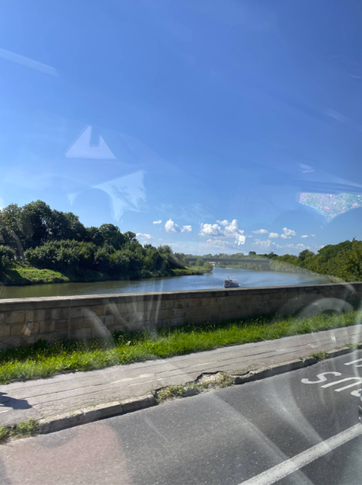
Getting to Auschwitz involved a one-hour coach journey. Meg thought she was over the worst of her food poisoning, although she was still feeling under the weather.
Alas, she was not yet better. We both realised this when she suddenly threw up without warning. Quite a bit of it landed on me, unfortunately. When we arrived at the camp, we had to rush to the bathroom to clean ourselves up before the tour began.
Not the best start to the day.
View from the coach window
The Things They Left Behind
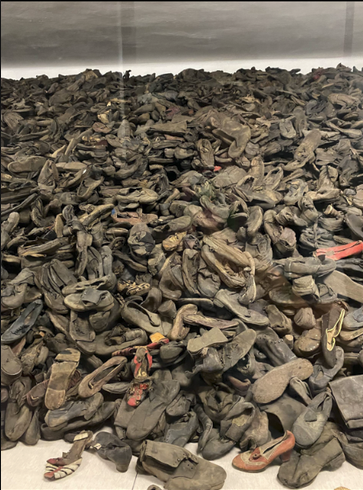
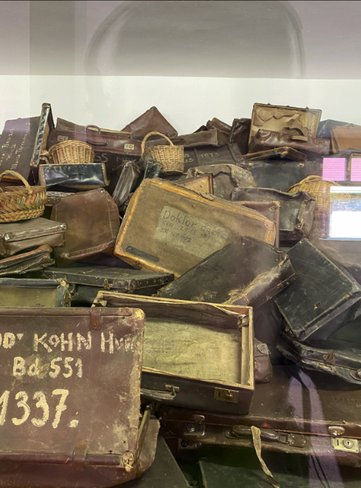
The tour began in Block 5 of the Auschwitz I section of the museum. This block contains large glass cabinets displaying confiscated belongings found in camp warehouses after liberation, including shoes, briefcases, and prostheses.
For me, the most horrific display was the cabinet containing human hair. Our guide explained that the hair was cut from murdered victims and shipped to Germany, where it was used to produce textiles, including items such as stockings for soldiers.
One Man's Sacrifice
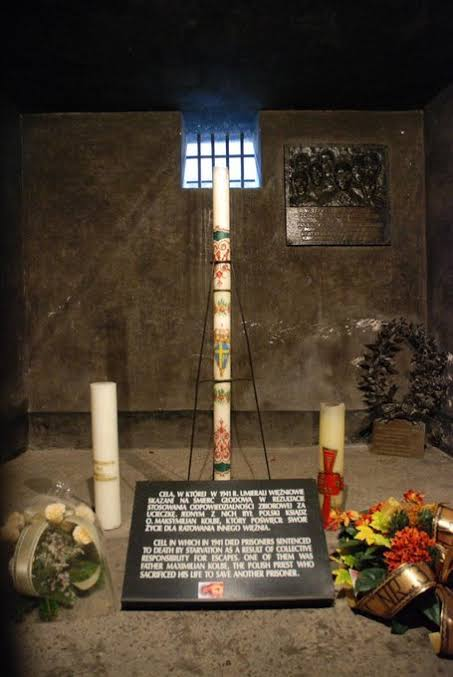
Our guide then led us to the cells at Auschwitz. In one of them, a single candle burned. We were told that this had once been the cell of Saint Maximilian Kolbe.
Why was he made a saint?
After a prisoner escaped in late July 1941, the SS chose 10 men from Kolbe's block to be starved to death as a deterrent. One of the men selected, Franciszek Gajowniczek, cried out in anguish for his wife and children. Kolbe stepped forward and offered to take his place, explaining that he was a Catholic priest with no family. The camp commandant accepted the exchange. Gajowniczek survived the war and lived until 1995.
The Paschal candle pictured to the left was placed in the cell by Pope John Paul II during his historic visit to Auschwitz in June 1979. It stands as a symbol of light overcoming darkness.
Not the Place for a Photoshoot
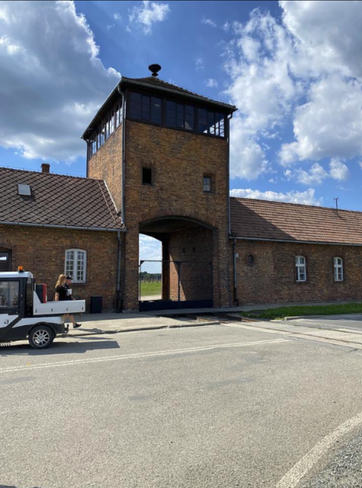
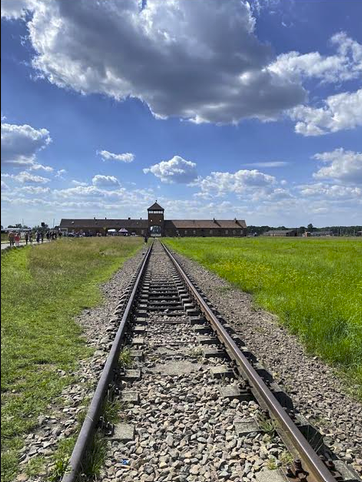
We then walked to Birkenau / Auschwitz II (the extermination camp) along the railway tracks that had transported so many Jews to their deaths.
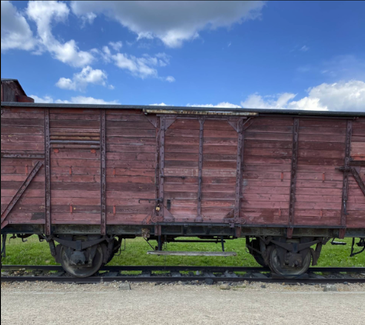
On the way, I saw a couple of women posing for photos on the tracks. One of them even leaned against a cattle car, smiling for the camera. Perhaps I was overreacting or reading too much into it, but I felt an immediate surge of rage and disbelief. I found it deeply unsettling and inappropriate. Of course, I understand that it is a major tourist site and that people want to document their visit, but it felt as though there was no acknowledgement that, while posing for the camera, they were standing in a place where millions of lives had been taken.
A Glimpse Inside the Barracks
We concluded the tour in the living quarters at Birkenau / Auschwitz II. The bunks were stacked three levels high, and we were told that each tiny bunk accommodated two to three people per level—sometimes as many as four. As we looked around the women's quarters, we saw that many of the women had scratched their names into the barracks walls.
In Block 16, which housed children for much of its existence, we saw that inmates had decorated some of the walls with scenes of children playing and going to school. These colourful paintings stood in stark contrast to the utter squalor of the barracks and the conditions people were forced to endure.
A picture of one of the cattle cars that transported so many Jews into Auschwitz
Day 19: Schindler, Souvenirs and Pierogi
Changing hostels
I started the day by moving to a different hostel for one night. Since I had been out of action at the beginning of my time in Krakow, I decided to skip Bratislava and extend my stay here instead. However, Greg and Tom's didn’t have availability for this particular night, so I needed to move temporarily. After quickly dropping off my bags at the other hostel, I headed back out with a plan to go to a couple of museums.
Modern Art or a Fever Dream?


I made a quick visit to MOCAK (Museum of Contemporary Art in Krakow).
I think it featured some of the weirdest art I have ever seen—and I loved every minute of it.
The museum showcases a wide range of mediums, from installations and textiles to paintings. Whether you are an art enthusiast or simply looking for a fun way to spend a couple of hours in Krakow, MOCAK is not to be missed.
And Cut!, by Deborah Sengl
You Are Mine, by Jakub Julian Ziółkowski
Schindler’s Factory and a Market Detour

The Survivor's Ark

I also visited St Mary's Basilica which stands in the northeast corner of the market square
This was one of my favourite museums so far. It offers a deeply immersive, theatrical journey through Krakow’s wartime history, covering Germany’s invasion of Poland in 1939, the persecution of Jewish people in the ghettos, and their eventual deportation. It also tells the remarkable story of Oskar Schindler, who saved around 1,200 Jewish people by employing them in his factories.
One installation that stayed with me was the Survivors’ Ark, created from thousands of enamel pots like those once produced in Schindler’s factory. For me, it was a powerful reminder that an ordinary factory became the setting for an extraordinary rescue.
I then walked to Krakow’s Market Square to pick up a few souvenirs for my family. The square is filled with traditional Polish crafts, including ceramics, intricate lacework, embroidery, wooden chess sets, carved wooden boxes, and folk figurines. If you are looking for a meaningful gift for friends or family, it is well worth a visit.
A viewpoint of the city of Krakow
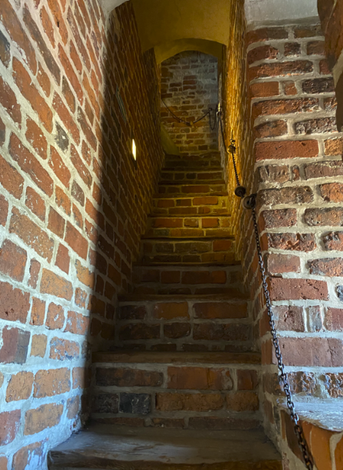
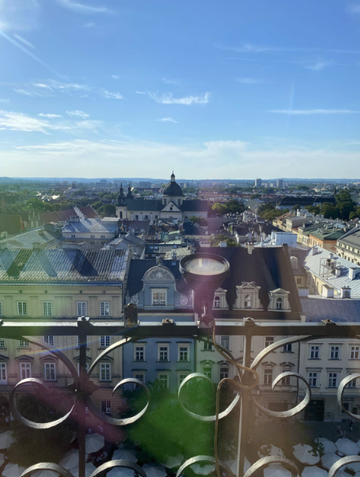
Another landmark in the market square is the town hall tower. For just 22 PLN (approximately 5.10€), you can climb to the top and enjoy spectacular views.
If you want to see the city from above, this is the place to go.
Pierogi: The Sequel (and some dancing)
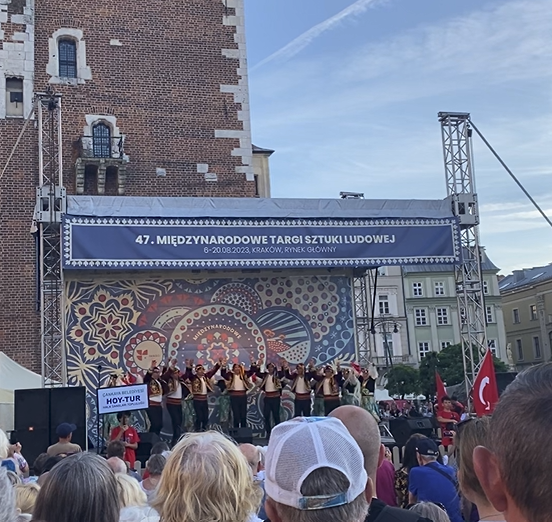
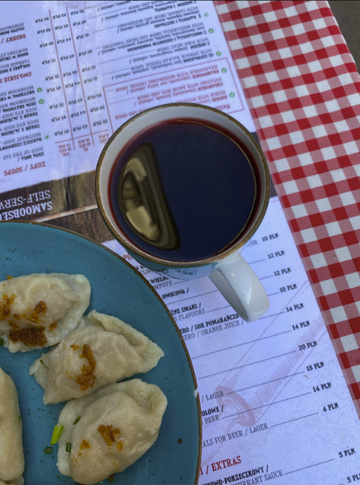
I then went back to Rynek square because there was the X. Summer Arts Festival going on. This festival brings together Polish and foreign folklore ensembles to display diverse cultural dances, traditional costumes, and music.
I watched traditional dancing from Turkey, India and so many other countries. It was incredible and there was a very raucous atmosphere around the whole thing. I then went back to the dumpling restaurant and once again went to town. I swear I must have been keeping that place in business while I was there! 😂
Day 20: Drinks, Dancing and Dodgy Decisions
I decided to keep the day fairly low-key, as I had booked an organised pub crawl for the evening and was still feeling low on energy after being ill.
The first thing I did was visit the Womai exhibition, Into the Darkness. The experience took place in complete darkness and offered an insight into how blind people navigate the world. Afterwards, I Facetimed my parents and had—you guessed it—more dumplings! In the evening, I returned to the square to watch the cultural dancing before heading back to my hostel to get ready for the pub crawl.
The Pub Crawl
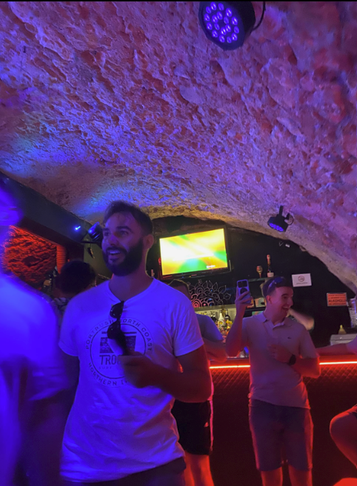
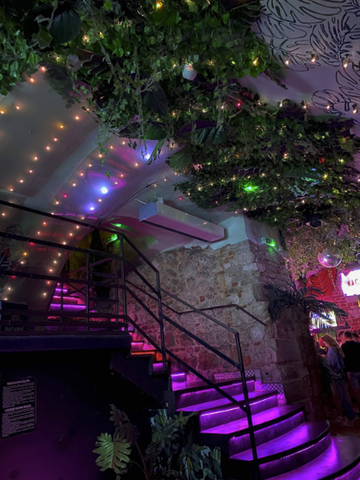
On the pub crawl, our guide took us to a couple of bars and we finished in a club. I was first chatting with a couple of girls but I ended up getting a bit too drunk.
By the time we got to the club, I was (I have to admit) obliterated. I ended up making out with a random guy from my hostel (which was super embarrassing the next day as I'm sure you can imagine). We all ended up getting back to the hostel at around 4am so I slept late the next morning.
Although that night was incredibly embarrassing for me personally, I can say that Mojitos Casa Latina (pictured to the left) is a great club, and the music absolutely slaps.
Day 21: Going Underground
After waking up very late, I caught the bus to the Wieliczka Salt Mine, where I had booked a guided tour.
Dating back to the 13th century, the Wieliczka Salt Mine is one of the world’s oldest operating salt mines. As we descended deeper and deeper underground, its immense scale became clear. Our guide explained that the mine reaches depths comparable to the height of the Eiffel Tower and spans around 300 km².
Walking through its winding tunnels was an extraordinary experience. The rock walls were streaked with swirling patterns and rich colours, formed by natural mineral impurities and ancient tectonic pressure. Deep underground, we came across a vast chapel, which our guide told us had hosted many weddings.
How did it all come to be?
For centuries, miners worked in near-darkness to extract rock salt. As we discovered, they also carved chapels, statues, and entire subterranean halls from the salt itself.
Overall, the mine was breathtaking and unlike anything I had seen before. It is a must-visit, and I recommend booking through the Tiqets app, which Grace told me about earlier in my trip. I found it to be cheaper, and the tour itself was excellent.


A picture of the striking colours and textures down in the mine
St. Kinga’s Chapel
Carved stone figures were created to honor the workers who once labored deep within the mine.
I then made my way back to the hostel and ate dinner with everyone staying there. From other people, I found out that the hostel was organising a trip to Lake Zakrzówek the next day so I signed myself up.
Day 22: A Day Out of the City


Our guide, Tori, said she would pick us up at 12:45, so I had a slow morning and bought lunch to take with me.
We all took the tram to the lake, where I ended up swimming three times—another thing that was very much against doctor’s advice. While in the water, I chatted with a group of Slovenian boys, who were quick to share plenty of recommendations for things to do in their country. Slovenia is definitely at the top of my list for my next trip.
We spent the whole day there swimming, chatting, and watching people cliff-dive into the lake. Overall, it was one of my favourite days of the trip.
I then returned to the hostel to pack, ready to set off for Budapest the following morning. I was sad to leave Krakow, but I’ll be back.
Day 23: Krakow to Budapest
After I had gotten up and had breakfast, I realised that I had got really bad sunburn at the lake the day before. Oops!
So, before getting my train, I bought some after-sun and suncream. I also got some food at the train station supermarket. My mum's friend Ben lives in Budapest and we had arranged to meet at the train station and he would show me around the city.
When I arrived, it was pouring with rain. So, me and Ben ducked into a restaurant and had burgers together. I told Ben about my plans for the following day. I had booked a walking tour and planned to visit Buda Castle which contains a history and art museum. Ben said that he would meet me at the castle.
I then went to my hostel to check in.
Day 24: A First Taste of Budapest
The Central Market Hall
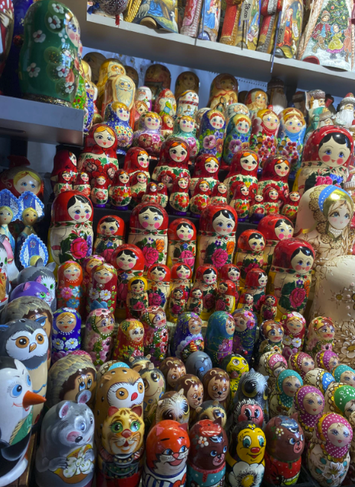
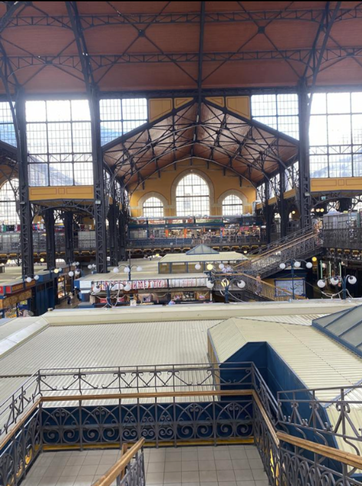
Ben had told me about the central market hall in Budapest which is a market of both food and souvenirs.
One of the highlights was wandering through the upper level, where stalls were packed with embroidered linens, paprika, wooden crafts, and other traditional Hungarian gifts. The building itself was just as memorable as the shopping, with its soaring iron framework, colourful tiled roof, and the steady bustle of locals and visitors moving between the vendors.
I ended up spending a good couple of hours there. I bought a kg of apples and a hat.
Buda Castle
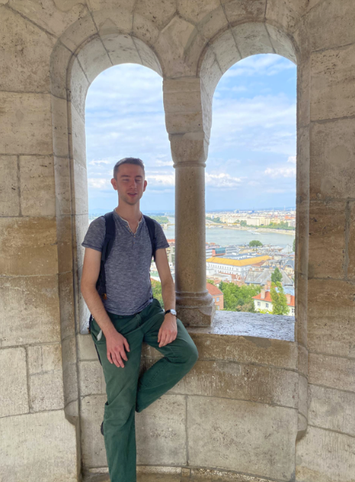
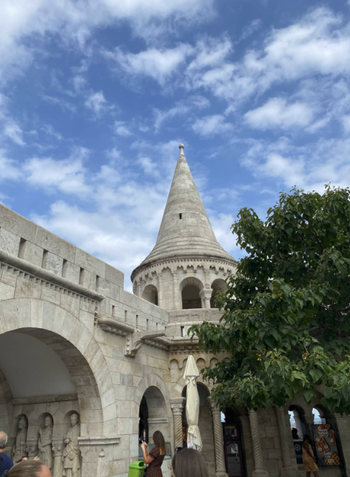
I then met up with Ben and we walked up to Buda castle to see the views of the city.
We stayed up there chatting for a while and then went to get dinner.
Day 25: Museums and Mineral Baths
First, I went to the Budapest History Museum
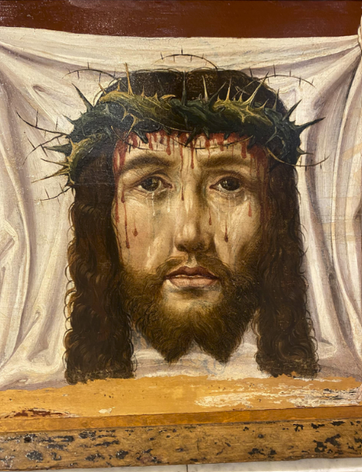
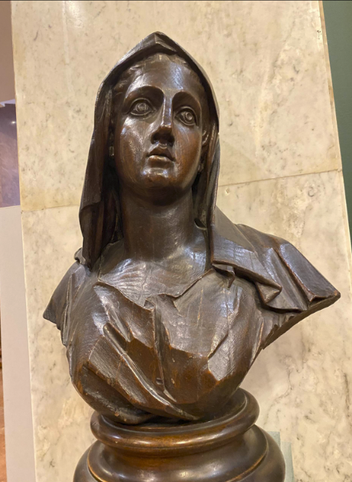
I was particularly interested in what the museum revealed about the history of Christianity in Budapest, alongside its vast collection of Christian artwork.
I learned that the history of religion in Hungary has been marked by violent upheaval: the Ottoman invasion, the Habsburg reconquest and subsequent Counter-Reformation, followed by renewed suppression under communist rule after the Second World War.
When I looked into it further afterwards, I discovered that despite this turbulent history, Christianity remains the most widely identified religion in Hungary.
Examples of these religious artworks
Then, the Széchenyi thermic baths
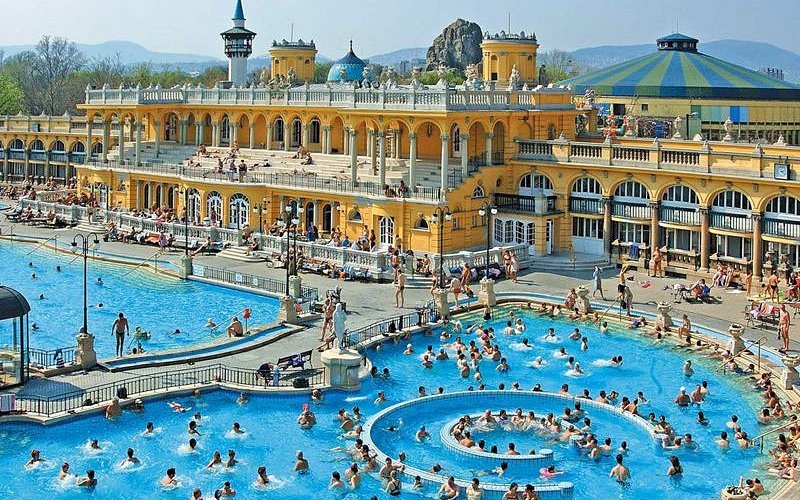
Széchenyi Baths is Europe’s largest medicinal thermal bath complex. It features outdoor pools fed by natural hot springs, as well as saunas, steam rooms, and a range of wellness services.
We spent the rest of the day relaxing there, and by the end, I felt completely zen. I also learned that the baths often host nighttime parties. Although I didn’t make it to one, they sounded like a fun option for anyone looking for things to do in Budapest after dark.
Day 26: Painting, Pints and a Little Night-Time Adventure
A Bit of Painting
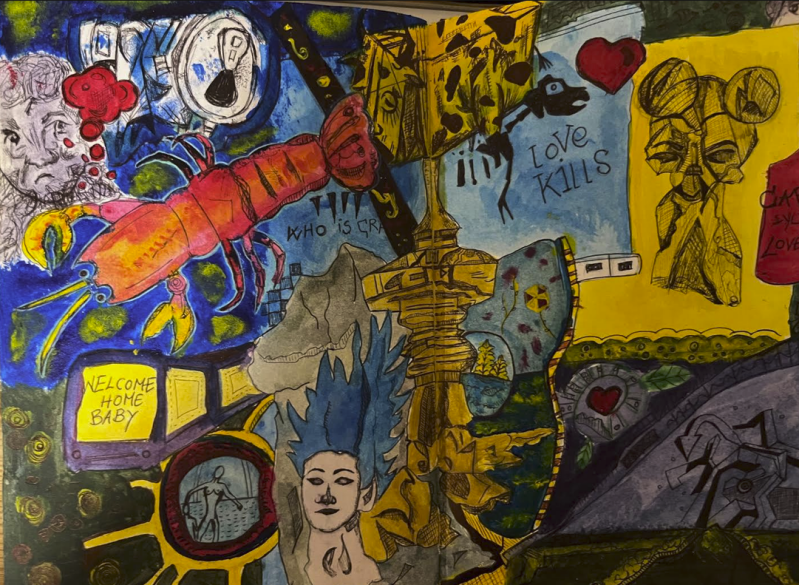
After several days of sightseeing, I decided to slow down, relax, and spend the day painting.
For this piece, I combined elements of the graffiti I had encountered during my travels with a few real-life locations I had photographed along the way. I was very happy with the result—it felt like a cohesive representation of my trip as a whole.
(I used acrylic paint and biro pen to create this piece.)
A picture of the double page in my sketchbook
Out on the Town
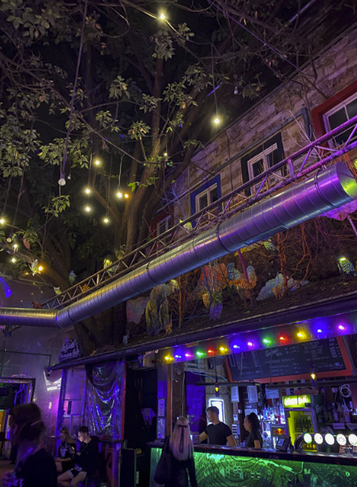
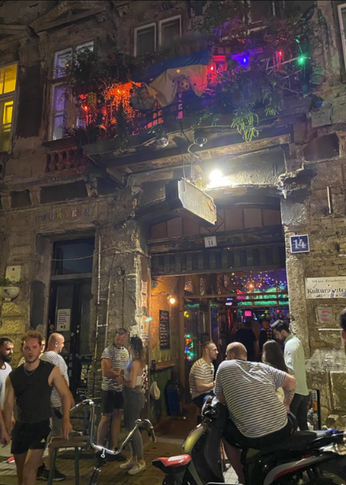
I decided to book a pub crawl, which turned out to be by far the best one I experienced on my trip.
It started off a little slowly, but I eventually met a guy named Reece at the club, and we danced together for a while. I learned that he was in Budapest for a stag do and, as a result, hadn’t actually done any sightseeing. I thought, “Well, we can’t have that.”
So, we decided to go sightseeing together that night. We walked up to Buda Castle, where we took in the city’s beautiful nighttime view. We stayed there talking until 3 a.m. about our travels and our plans for the future.

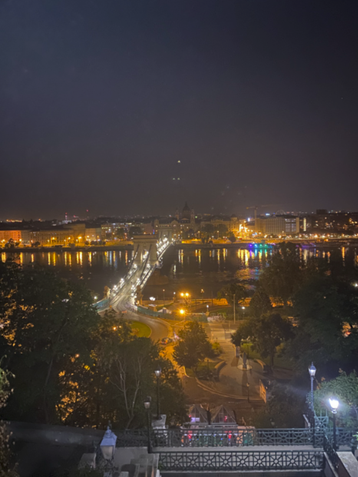
He walked me back to my hostel, and we agreed that if he ever found himself in London—where I would be starting university that September—we would meet up.
As I mentioned, I returned to my hostel very late, so I was grateful to have paid for a late check-out the following morning. It meant I could enjoy a lie-in before catching my train.
Day 27: Budapest to Zagreb
I caught my train in the late afternoon. Unfortunately, the air conditioning was broken, turning the seven-hour journey into a sweltering ride in a sun-soaked metal tube. I honestly felt like I was dying.
Still, I made it. After arriving, I walked to my hostel, where another traveller named Ethan checked in at the same time. Like me, he was travelling solo. We chatted for a while before I finally headed to bed.
Day 28: A Tour, Some Noodles and a Lot of Exes
A walking tour and lunch
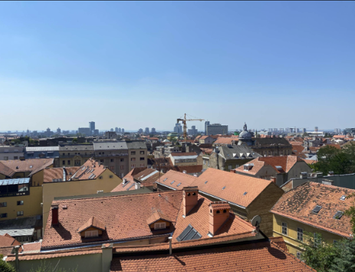
I started the day with a walking tour led by a pretty goofy guide, who shared plenty of fascinating facts about the city.
For instance, he pointed out the spiky objects on the roofs of many of the buildings. According to him, these spikes were originally designed to ward off witches flying on their brooms.
Overall, it was a unique and interesting tour.
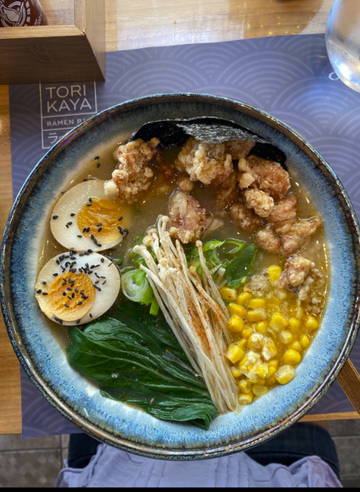
Afterwards, I stopped for lunch at a ramen bar.
A view of the city of Zagreb
Ramen from the Torikaya Ramen Bar
The Museum of Broken Relationships

I then went to the famous Museum of Broken Relationships. This museum features a diverse collection of objects, each representing a personal story of a past relationship.
For example there was one that was a book titled 'I can make you thinner,' which the woman's boyfriend had given her. (This was obviously the end of their relationship)
There were also some really sad ones. For example, one man gifted a mirror to the museum. He said that his wife would spend hours getting ready for nights out in front of it. It turned out that she was going out to cheat on him. She left him with the mirror.
The Museum of Hangovers
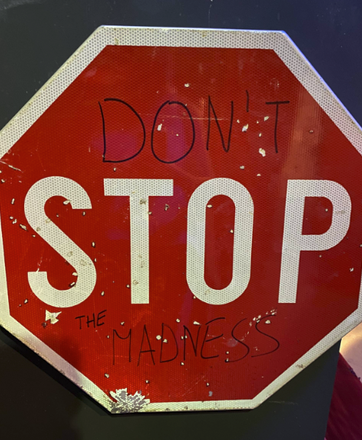
I then went to the Museum of Hangovers. This museum was great. it basically contained lots of funny stories about crazy nights out, accompanied by stolen objects. Someone had managed to steal an entire set of traffic lights!
Overall, both museums offered a much-needed break from the many history and art museums I had visited. If you are looking for a fun, light-hearted day out, they are your best bet.
A stop sign that someone stole on a night out 😂
Ending the day with a drink
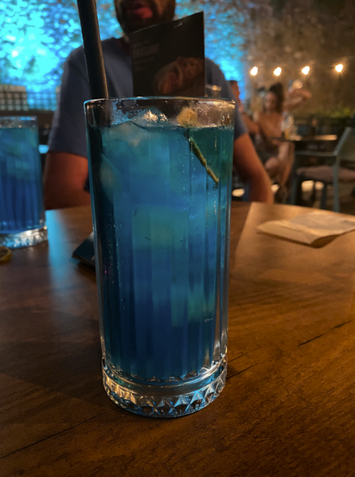
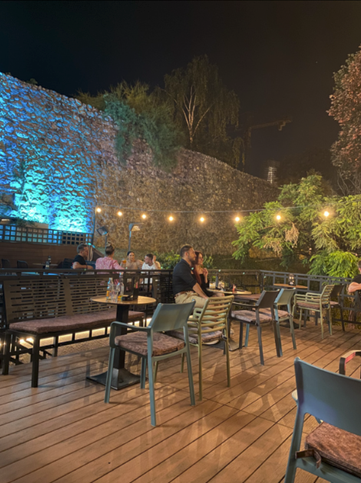
Evidently the Museum of Hangovers had not put me off! 😂
I finished the day by going to a bar called The Skyline Bar with Ethan and 2 other guys from my dormitory. Here, I tried a blue lagoon cocktail for the first time which is now one of my favourite cocktails.
Me and one of the boys (Ethan) decided to go to The Chocolate Museum together the next day.
Day 29: From Chocolate to Cemetery Strolls
The Chocolate Museum


Ethan and I set off first thing in the morning to visit The Chocolate Museum. It was fantastic, with plenty of information about the history of chocolate alongside beautiful chocolate sculptures. Best of all, every room had taps serving different varieties of melted chocolate.
By the time we left, we both felt very sick. We had definitely got our money’s worth of melted chocolate, but we were now paying the price.
Grič Tunnel

We decided to take a walk around the city and see what we could discover. The first place we came across was the Grič Tunnel. Originally built during World War II as a bomb shelter, it now serves as a pedestrian passage beneath the historic Grič neighbourhood.
To be honest, walking through it felt a little creepy. Every sound echoed, making it a very strange experience.
Wandering round the Mirogoj Cemetery
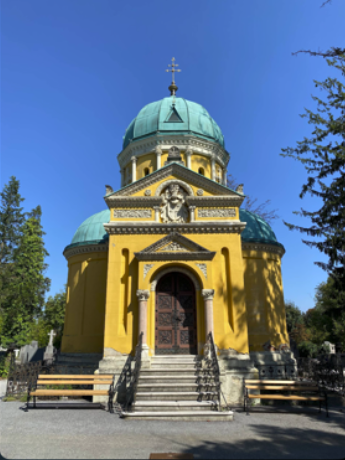
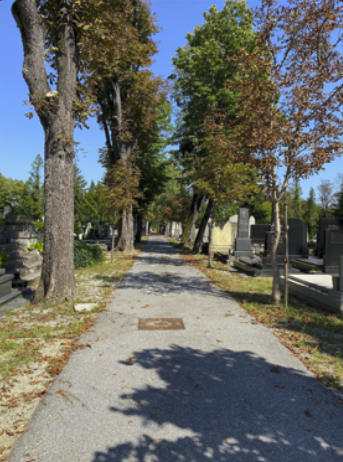
Our next stop was Zagreb’s most famous cemetery, Mirogoj. Designed by architect Hermann Bollé, it is widely regarded as both an open-air art gallery and a peaceful park.
The cemetery is home to numerous funerary statues by prominent Croatian artists, as well as the final resting places of notable figures, including the renowned sculptor Ivan Meštrović.
Overall, it was a lovely experience to stroll through the grounds, chatting in the sunshine. It was a wonderful way to spend an afternoon in Croatia.
Live Music and Total Chaos
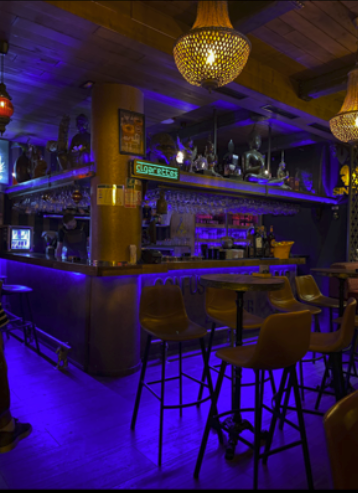
We then returned to the hostel to shower and have dinner. We then decided to go clubbing together. We ended up at the Rock & Beer Club Alcatraz, which had live music. While we were there, we met another female solo traveler from Poland. We had a few drinks and spent some time dancing.
We were having a great time until a fight broke out in the middle of the club. It quickly escalated when one guy smashed a bottle over another man's head. It was terrifying, and we ran straight for the exit. The club was shut down, leaving us out on the street. The girl we had been talking to was understandably shaken, so she headed back to her hotel.
We wandered around the city for a while before returning to our hostel early.
It was certainly an eventful night out.
Day 30: A Day at the Zoo
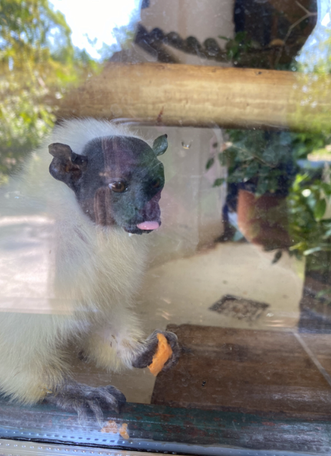
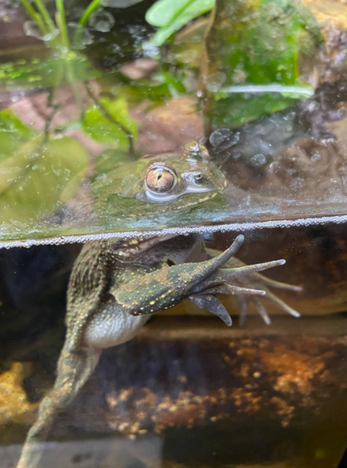
I decided to enjoy a quiet day, so I headed to Maksimir Park for a walk and a picnic. The grounds were vast, and I spent hours wandering along its paths.
Along the way, I discovered a zoo and spent a good hour trying to win over the animals. (I was unsuccessful. Shocking, I know.)
Later, I settled beneath a tree in the park and spent the rest of the day reading my book.
At the end of the day, I last-minute booked a tour of the Plitvice Lakes National Park.
The pied tamarin clearly had zero respect for me 😛
A bullfrog doing bullfrog things
Day 31: Going Out with a Bang
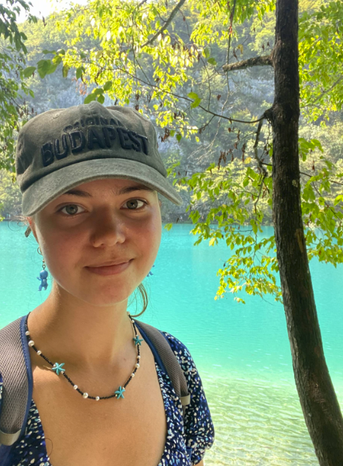
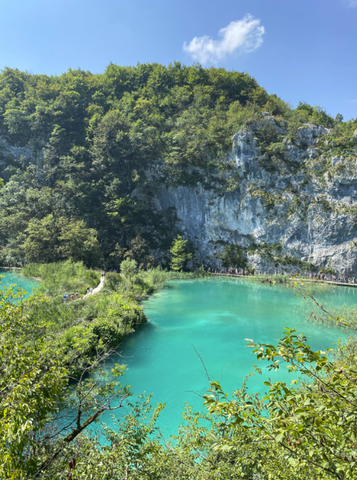
The Plitvice National Park was about 1 hour 45 minutes outside the city. So, our guide took us there by bus.
It was absolutely breathtaking. The lakes were this incredible turquoise-blue colour. There were huge waterfalls going down sloping rock cliffs. I think it is one of the most beautiful places I have ever and will ever be.
We even got to float over the lakes when we were transported by boat. I remember the water was totally clear. Everything about the park felt totally untouched. (itwas very well taken care of)
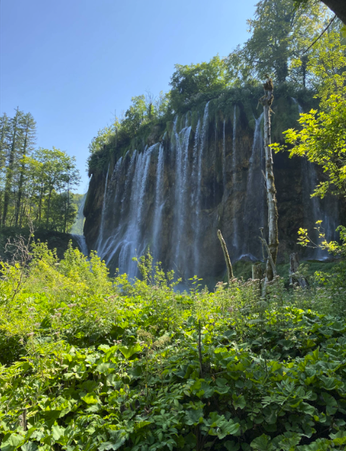
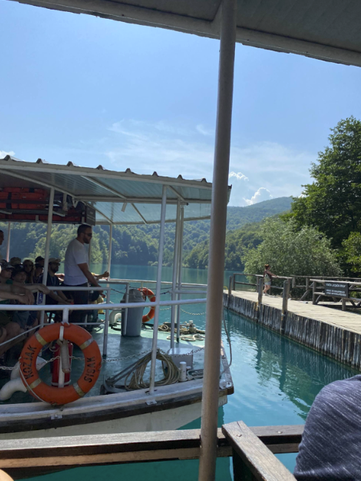
Up until this point, Zagreb had been the least interesting of the cities I had been to but this park made it all worth it.
This was the best last day I could have hoped for.
Then, all that was left was to pack and get ready to get my flight the following day.
Day 32: Home Again. Home Again.

I had an uneventful flight home and, just like that, my journey was at its end.
It's difficult to sum up a trip like this in a few paragraphs. I visited places I'd always wanted to see, experienced things I'd never imagined, and met people who made the journey that little bit more special. Some days were amazing, others were challenging, and a few were downright chaotic, but I wouldn't change any of it.
I'm incredibly grateful I got to experience it all, and I hope it's not the last adventure of its kind.
Getting my flight
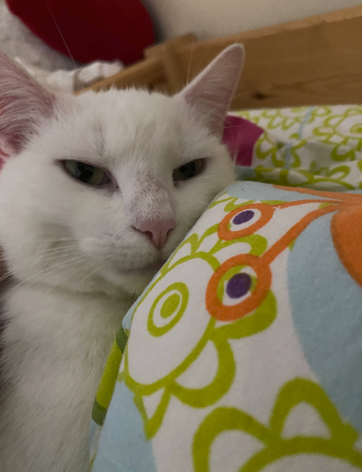
My cat (Ida) was happy to see me 🥺
Create Your Own Website With Webador